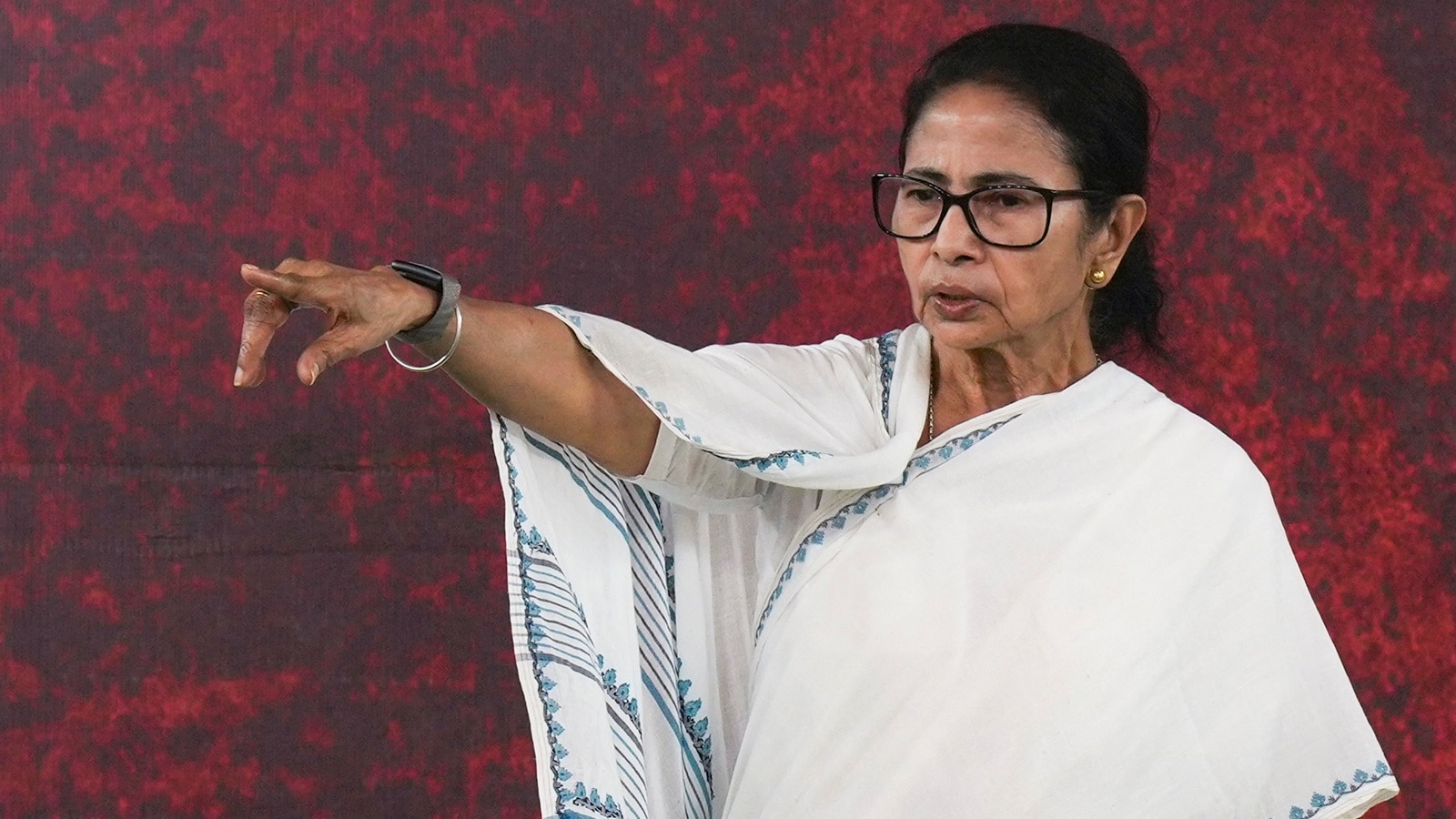
At a time when she and her party are facing blowback following President Droupadi Murmu’s recent remarks, West Bengal Chief Minister and Trinamool Congress (TMC) chief Mamata Banerjee on Friday announced that the state government intends to set up five new cultural and development boards for various Adivasi, backward class, and Dalit communities.
The boards would be established for people from the Munda (Scheduled Tribe), Kora (ST), Dom (Scheduled Caste), Kumbhakar (Other Backward Class), and Sadgope (OBC) communities. These join more than 20 such boards established for various communities in the state.
While the TMC hailed the announcement, Opposition parties said these boards had been announced with votes in mind before the Assembly elections, and like the previously established boards, these too would not serve their communities. The BJP alleged that this was Banerjee’s way of doing damage control after President Murmu, during a visit to Siliguri last weekend, asked why the CM or her ministers had not received her and questioned why the venue of a Santal community event that she was in the city to address had been shifted. This had led to a bitter exchange between the TMC and the BJP, which accused her of violating protocol.
On Friday, Banerjee posted on X, “‘I am pleased to announce that our government intends to constitute five new Cultural and Development Boards for the Munda (ST), Kora (ST), Dom (SC), Kumbhakar (OBC), and Sadgope (OBC) communities. These communities are integral to the vibrant fabric of Bengal. My heartiest congratulations to all of them.”
“These boards will protect their unique languages and traditions while ensuring better education, healthcare, and jobs. They will safeguard customary rights and bring further socio-economic growth. Since 2013, we have established many such boards for our weaker communities, ensuring their all-round development,” the CM wrote.
Boards set up earlier
Since 2013, the West Bengal government has constituted many community development boards for specific tribal, SC, and OBC communities. Initially, several such boards were set up in the Darjeeling Hills, including those for the Lepcha, Sherpa, Tamang, and Bhutia communities between 2013 and 2015. While the Limbu Development Board was constituted in February 2016, boards for the Kami, Damai, and Sarki communities were announced that July during the 202nd birth anniversary of Bhanubhakta Acharya in Darjeeling.
In May 2017, the state Cabinet approved the Rajbonshi Culture and Development Board. The Rajbonshi community (ST), concentrated mainly in Cooch Behar district and other parts of north Bengal (apart from parts of Assam), are an influential factor in several seats in the region. In November 2018, the government set up the Namasudra and Matua Development Boards. The Matuas are a religious group among the Namasudras (SC community) that is politically influential. Following the passage of the Citizenship Amendment Act, sided with the BJP and, in 2019, helped it register its best performance in a parliamentary election in West Bengal.
Story continues below this ad
A board set up in recent years is the Bhumij Development Board, with its head office in Purulia and a sub-office in Jhargram, in March 2024 for the Bhumij community that is considered a part of the Munda ethnic group.
Political significance
The latest boards for ST, OBC, and Dalit communities illustrate a larger trend that has come to characterise West Bengal politics since the last years of the Left Front government: the rise of identity politics. As the Left began rapidly declining after its push for industrialisation began to backfire, people from marginalised groups and communities began mobilising around their identity to press their demands.
After replacing the Left, the TMC became adept at playing identity politics and ensured it through, among other things, political representation of people from these communities (for instance, it fielded leaders from the Thakur family of Matuas in elections), and welfare politics and social recognition that is ensured through these boards.
This model of identity politics is now deeply entrenched in Bengal politics, forcing all parties to engage with it if they have to win elections. Like the TMC, the BJP has also fielded leaders from the Thakur family of Matuas in elections over the years and one of its members, Shantanu Thakur, is the current Union MoS for Ports, Shipping, and Waterways.
Story continues below this ad
How TMC, Opposition reacted
Welcoming the CM’s announcement, state Forest Minister Birbaha Hansda, who is from the Santal community, told The Indian Express, “The latest cultural and development boards show that our CM respects all communities. It is a good initiative and will go a long way not only in the development of the communities but also in preserving their cultural heritage.”
Alleging it was just a cynical ploy to get votes and would not amount to substantive changes, BJP leader Rahul Sinha, who is set to enter the Rajya Sabha, said the CM was trying to offset the damage she had caused by ”insulting” President Murmu.
“Mamata Banerjee insulted the President recently. It has had a huge impact on the tribal community in Bengal. The TMC sought the appointment of the President (in Delhi), which was not granted. Now, they are trying to control the damage through such initiatives. But they will be unsuccessful,” Sinha told Express.
“The CM keeps approving such boards. It is not a development board but a board for votes. Earlier, nearly 20 such boards were set up. No one knows what they do and where their offices are. No work is being done for the development of the communities concerned,” said former MP and CPI(M) Central Committee member Sujan Chakraborty.
