
(As West Bengal gears up for the Assembly polls, every Tuesday, The Indian Express’s Kolkata bureau chief Ravik Bhattacharya decodes the electoral trends, political signals, and campaign moves shaping the contest.)
Having steadily lost ground in West Bengal since being voted out of power in 2011, the CPI(M), over the past five years, made a conscious attempt to bring younger faces to the forefront, fielding young leaders such as Dipsita Dhar, Minakshi Mukherjee, Srijan Bhattacharya, and Pratikur Rahman.

For a party facing an existential battle for relevance in a state it ruled for 34 years straight, that strategy took a blow on February 15 when Pratikur, touted as one of its big hopes, wrote a letter to the party’s state secretary announcing his opposition to some recent decisions. Six days later, he joined the TMC in Abhishek Banerjee’s presence, saying it was the trailer and the full movie was to follow soon, insinuating that more such desertions could be in the offing. In 2024, Pratikur had unsuccessfully contested the Lok Sabha polls from Diamond Harbour against the TMC’s second-in-command.
Given that the party has rapidly shrunk over the past decade and Pratikur has a limited base in Diamond Harbour, the gains for the Mamata Banerjee-led party are not much in realpolitik terms. The real benefit from this is the blow it has managed to land on the CPI(M)’s comeback plans that hinge on a crop of young leaders. While for the CPI(M), Rahman’s exit constitutes a loss of face and a setback to its long-term plans for an ideological resurrection — the party’s state secretary Md Salim said “losing a worker like this is akin to losing one’s own child” — the TMC gains an educated minority community face, bolstering the narrative that it is the only alternative for those seeking to stop the BJP and its aggressive Hindutva politics.
Pratikur’s exit could not have come at a worse time for the Left party, given that in recent times there were some green shoots the party could have built upon. The CPI(M) plummeted from almost 20% vote share in 2016 to 4.73% five years later, drawing a blank. But in recent elections, there had been some stirrings of hope. In the 2022 municipal polls, the party got a 14% vote share, with 12% in Kolkata and in the panchayat elections in 2023, it managed a healthy 21% vote share. In the 2024 Lok Sabha polls, the party failed to win seats, but its vote share rose marginally to around 6%.
If the party continues to haemorrhage and lose young leaders, even these marginal gains will be at risk of being wiped out.
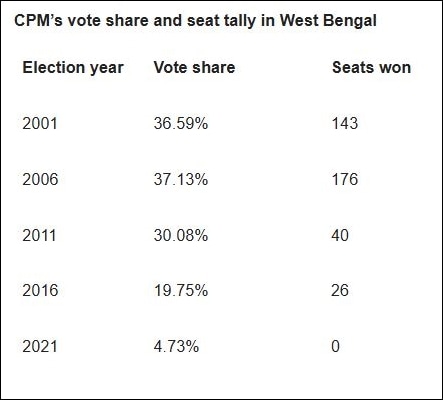
Main challenge
The CPI(M)’s primary challenge is to open an account in the coming Assembly elections after drawing a blank five years ago. And on top of everything else, it will face a real test as it will be without the Congress that has decided to go it alone.
Since 2011, the party has continuously lost a chunk of its cadre and support base to the BJP, which was viewed as the only party strong enough to contain the Mamata-led party. In Bengal’s bipolar political arena, where Mamata is powering ahead on the strength of dole politics, subtle Bengali sub-nationalism, and the push against the Special Intensive Revision (SIR) of electoral rolls and the BJP is banking on consolidating Hindu votes, the CPI(M) faces the uphill task of finding takers for its message. Amid the noise of identity politics, can a poll pitch built on questions of unemployment, corruption, and decline in the education sector find resonance among voters? That is the question facing the CPI(M).
In such a scenario, the CPI(M) cannot afford to lose too many leaders with a clean image, young leaders who do not bear the burden of the past. The Pratikurs and Dipsitas may not have brought electoral success to the party, but they had an impact and a role to play long-term. That is why Pratikur’s exit is an ominous sign for the party at such a crucial juncture.
Minus the Congress
Apart from all this, one of the things to watch out for in the coming election will be how the CPI(M) fares without the Congress, with whom it had an alliance since 2016. Other than likely providing the TMC with an advantage in four-cornered contests, it has to be seen how the CPI(M)’s votes are affected.
In an uncertain political terrain, the party, with an eye on minority votes, has been considering an alliance like the one it had with the Indian Secular Front in 2021, whose leader Naushad Siddiqui is the only non-BJP Opposition MLA in the current Assembly.
Salim’s recent meeting with Humayun Kabir, former TMC leader and founder of the Janata Unnayan Party who laid the foundation stone of a Babri Masjid replica last December, has led to questions within the party. It was also said to be the immediate trigger for Pratikur’s decision to jump ship. Several CPI(M) leaders have wondered about the electoral benefits of engaging with a leader considered “communal”. There has, however, not been any understanding yet between the Left party and these smaller outfits.