
For 42-year-old Rahul Kumar Mandal, the last three months have been a fight for survival. Since the suspension of work at Alliance Jute Mill in North 24 Parganas district on December 27, the hum of machines has been replaced by a silence that has upended the lives and livelihoods of many.
“I have been working here for 10 years,” Mandal says. “The mill has been shut for three months, but no one seems to be bothered. During the Special Intensive Revision (SIR), many names were deleted from the voter list. Friends who lost their jobs and voting status simply packed up and left. I have a daughter in school, I can’t just leave.”

Mandal’s story is a microcosm of a larger shift in West Bengal, which is headed for the Assembly elections next month. With the state’s Hindi-speaking residents accounting for a significant chunk of its population, this electorate no longer appears to be a “silent” minority. In the industrial pockets of North 24 Parganas, their primary concern has pivoted from identity politics to basic sustenance.
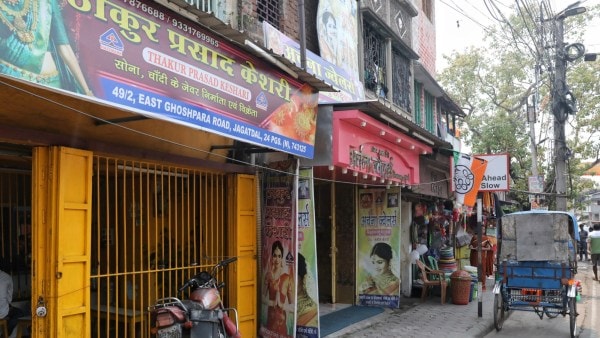 Shop names written in Hindi at Jagatddal in North 24 Parganas. (Photo by Partha Paul)
“When people in power target Hindi speakers in their speeches addressing them as ‘gutkhakhor (chewing tobacco users)’, it hurts,” Mandal says. “But if the state offered jobs, we wouldn’t care about the rhetoric. We will vote for whoever creates earning opportunities.”
Mandal is now attempting a precarious transition from a stable industrial job to life as a delivery worker.
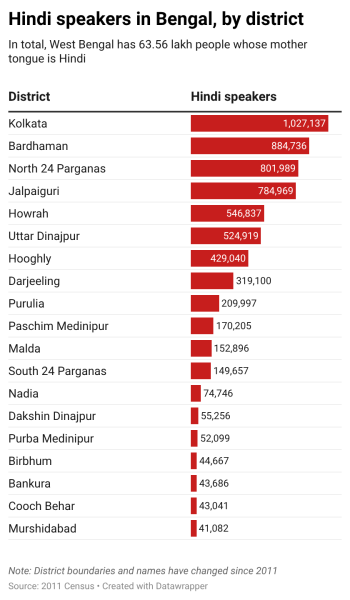
The Hindi-speaking belt in Bengal is concentrated around industrial clusters in the districts of North 24 Parganas, Howrah, Hooghly, and parts of Kolkata. Significant pockets of the colliery regions of Paschim Bardhaman are also inhabited by Hindi speakers.
As per experts and local politicians, about 15% of Bengal’s electorate comprises Hindi speakers. While a large segment of the Hindi belts forms the backbone of the jute, steel, and railway wagon industries, a considerable section of Hindi speakers are also business owners.
The Bhatpara Assembly constituency, which falls within Kolkata Metropolitan Area and is part of the North 24 Parganas district, remains a high-stakes battlefield. In 2021, the BJP’s Pawan Kumar Singh won the seat by 13,687 votes. In consecutive polls from 2001 to 2016, Singh’s father Arjun Singh had won the seat on a Trinamool Congress (TMC) ticket. Arjun has since joined the BJP. This year, the TMC has fielded Amit Gupta to challenge the Singh family’s long-standing dominance in the area.
While Bhatpara leans toward the BJP, neighbouring Jagatdal tells a different story. The TMC has held this seat since 2011. In the 2024 Lok Sabha polls, the divide within Jagatdal became stark: the TMC saw a decline of 6,000 votes in urban pockets, but offset this with a 5,500-vote surge in rural areas.
“The Bengali community wants peace. Since 2019, the bombing and firing in the jute mill belt have exhausted people,” said Amit Lahiri, a Jagatdal resident.
“My grandfather came from Bihar to work in the mills. I spent 12 years in the loom, and now I’m told the mill is ‘unproductive’. If there is no industry, there is no life. Bengal was once the land of work – now, it’s the land of the Rs 1,000 handouts. My son has already left for Pune to work in a garage. There is nothing left for him here,” said Ram Naresh Yadav, 52, a resident of Titagarh in North 24 Parganas.
“When elections come, we are ‘Hindi speakers’ to be wooed. After voting, we are ‘outsiders (bohiragoto)’ who are taking away jobs. But look at the local drainage, roads, and closed gates of the factories. If the state had anything to offer, our youth wouldn’t be filling up the general compartments of trains to Chennai and Delhi every single day,” said Sanjay Gupta, 34, a shop owner in North 24 Paraganas’s Barrackpore.
BJP leader Arjun Singh frames this as a broader economic failure. During one of his campaign events, he said, “This government has finished the industries. Mamata Banerjee is anti-Hindi, anti-Hindu, and puts a constraint on economic development.”
But in Howrah district’s Bally Assembly seat, TMC candidate Kailash Mishra, a Maithil Brahmin, is hoping to dismantle the BJP’s monopoly on the migrant narrative by emphasising systemic state support.
“Chief Minister Mamata Banerjee has done so much development work for Hindi speakers that no one could imagine,” Mishra says. “I am a Bihari and a Maithil Brahmin; I am a councillor. People from Bihar and Uttar Pradesh are leaders in the TMC. There are so many Bihari IPS and IAS officers who Mamata didi always stands with.”
Mishra points to the contrast in how Hindi-speaking people’s festivals are treated in Bengal as compared to other states. “In Maharashtra, Biharis faced so many problems performing Chhath on the beach. Bengal is the only state where the state government gives two days’ leave. The CM herself takes part in each Chhath Puja. The West Bengal Hindi Academy was reconstituted by our government and funded to promote Hindi literature, arts, and culture through various grants,” he says.
But not all Hindi-speaking voters agree with Mishra. “The educated Hindi-speaking youths here are working as delivery agents or security guards. It is not about Bengali pride or unity of Hindi-speaking people. We must vote for someone who can guarantee jobs,” said a 29-year-old voter, who is an unemployed graduate from Liluah in Howrah district.
Despite Mamata’s outreach, some people feel her message is “lost”. Ashok Jha, president of the Mithila Vikas Parishad, says: “Mamata Banerjee has done the unimaginable for Hindi speakers, from a Hindi University to Gangasagar (a Hindu pilgrimage site). But her TMC workers have failed to spread the message at the grassroots, allowing the BJP to create a counter-narrative.”