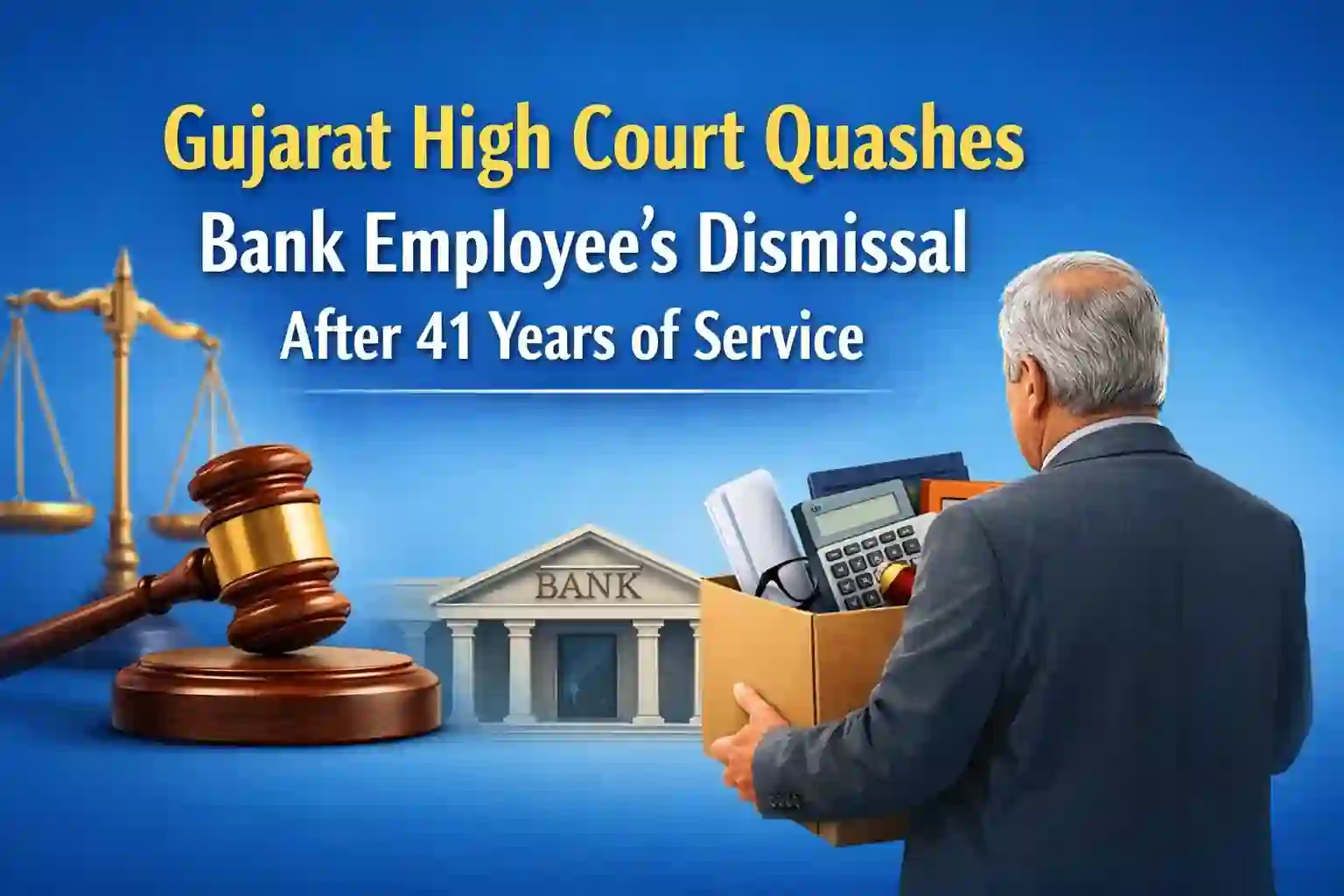
The Gujarat High Court said that the punishment of “dismissal from service” given to a bank employee after 41 years of service was too harsh. The court called it “disproportionate” and said it was like “economic and social death” for the employee. On Monday, the court cancelled the dismissal order. It directed the bank to change the punishment to a lower one by reducing his basic pay. The court also said that the bank will not have any financial liability.
A Division Bench of Justices B D Karia and L S Pirzada heard the case. The petition was filed by the legal heirs of N G Kotecha, a former employee of the Central Bank of India. They challenged an October 2024 High Court order that had dismissed Kotecha’s earlier petition. In that petition, Kotecha had challenged his dismissal in May 1994 after a departmental inquiry into six charges. According to the petition, none of these charges caused any financial loss to the bank.
Senior Advocate Bhaskar Tanna argued the case for the family. He said that Kotecha had served the bank for 41 years with a clean record. He had also received awards and appreciation for his work. However, he was dismissed based on an inquiry report of October 1993, just ten days before his retirement. The bank had asked him to continue in service until the inquiry was completed. He replied to the charges in October 1993 and was dismissed in May 1994 under the bank’s service rules.
According to the petition, Kotecha joined the bank as a clerk in 1952. Over time, he was promoted and became General Manager. He was working as Chief Internal Auditor in Ahmedabad in July 1993 when he received a notice. The notice asked him to reply to certain procedural mistakes allegedly made between 1986 and 1990 when he was Chief Manager in Jamnagar.
The lawyer argued that no memo or charge sheet had ever been issued to Kotecha during his entire career. Out of the six charges proved, none caused any financial loss to the bank. The charges included giving loans against inflated stock, not verifying stock values properly, poor control over accounts, and allowing fund transfers between accounts. Another charge was that he allowed advances without clearing earlier dues.
The lawyer also said that the bank should have considered that these were only procedural mistakes. He argued that Kotecha should not have been dismissed on the date of his retirement without any retirement benefits.
In its judgment, the High Court said that the punishment of dismissal was too harsh and not suitable for the charges. It again stated that this punishment was like “economic and social death” for a person who had served the bank honestly for 41 years.
The court noted that although the charges were proved, they did not cause any financial loss. Therefore, dismissal was not justified. The court said the punishment was not in proportion to the charges.
Since the family only wanted removal of the stigma of dismissal, the court ordered the bank to replace the punishment. The new punishment is reduction of basic pay by six stages. The court also clarified that this change will not result in any financial benefit for the family, as they had already agreed not to claim any money.
The court further said that the bank will not have to pay any financial benefits due to this change in punishment. It also noted that the family has given up their right to claim any monetary benefit.
After his dismissal in May 1994, Kotecha had filed an appeal. In January 1995, the appellate authority rejected his appeal. He then approached the High Court in 1995. That case was closed in 2003 after he withdrew it to make a representation to the bank. However, the bank rejected his request in June 2003. After that, he filed another case in 2004. The High Court admitted the case in 2024. During the case, Kotecha passed away, and his family continued the legal fight.