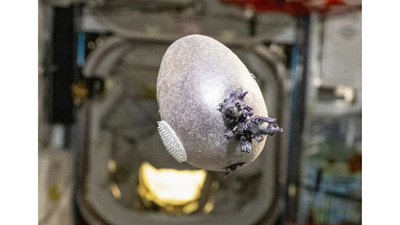
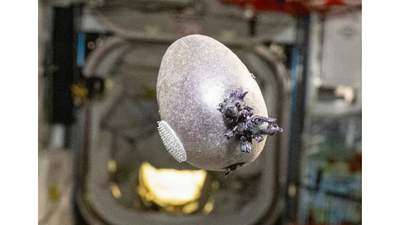
A strange, tentacled object floating aboard the International Space Station recently sent the internet into a frenzy, with many mistaking it for something straight out of a science fiction film. The eerie, purple, egg-shaped form with tendril-like growths quickly went viral, prompting reactions ranging from curiosity to outright panic. However, the truth behind the image is far less ominous. The object is in fact a space-grown purple potato, cultivated by Don Pettit during a small-scale gardening experiment in microgravity, offering a fascinating glimpse into the future of food production beyond Earth.
The viral ‘alien egg ’ that is actually a potato
The image did not just circulate online, it unsettled people. At first glance, the object bore an uncanny resemblance to something alive, an organic form suspended in space with tendrils stretching outward as if searching for direction. Its smooth, almost artificial surface, combined with its deep purple colour, made it look less like food and more like a prop from a science fiction horror film. In the weightless environment of space, where familiar reference points disappear, even the most ordinary objects can appear transformed.As the image spread, so did speculation. Some viewers joked nervously about extraterrestrial life, while others reacted with genuine unease, unable to reconcile what they were seeing with anything recognisable. The absence of context only intensified the reaction. Detached from explanation, the object became something else entirely, a mystery shaped more by imagination than reality. A simple biological process, a potato sprouting, became something eerie simply because it was happening in an unfamiliar environment. It was not the object itself that changed, but the conditions around it, and the way it was seen.
What it actually is: A potato grown in space
Behind the viral moment lies a straightforward explanation. The object is an early-stage purple potato that has begun to sprout. The tendrils are natural growths, roots and shoots emerging as part of its life cycle. On Earth, these would typically grow in defined directions, guided by gravity and soil. In space, that structure disappears. Without gravity to orient growth, the sprouts extend outward in multiple directions, creating a form that appears chaotic and unfamiliar.This lack of direction is what gives the potato its unusual appearance. What would normally remain hidden beneath soil becomes fully visible, suspended and exposed, turning a common process into something visually striking.
How Don Pettit grew a potato in space
Growing anything aboard the ISS requires adaptation. In an environment where objects float freely and gravity offers no guidance, even the simplest agricultural process must be reimagined. Don Pettit approached this challenge with a practical and improvised setup, using limited resources available on the station.A controlled light source replaced the Sun, providing the energy necessary for the potato to sprout. The environment around it was loosely contained to maintain stability, while a small patch of hook-and-loop Velcro ensured the potato remained anchored instead of drifting through the cabin. Moisture and light became the primary cues guiding its development.Without soil to constrain it and gravity to direct it, the potato responded differently. Its growth was slower, less structured, and more exploratory. The experiment, though modest, demonstrated how life adapts even in conditions far removed from Earth.
Who is Don Pettit and why he grew it
Don Pettit is a veteran astronaut and scientist with a reputation for hands-on experimentation. Known for exploring everyday phenomena in space, he has spent years observing how simple processes behave when removed from Earth’s constraints.The potato experiment was not part of a formal mission objective but reflected his ongoing curiosity about living systems in microgravity. Beneath that curiosity lies a practical concern. As space agencies prepare for longer missions beyond low Earth orbit, the ability to grow food becomes essential. Pettit’s work, even when informal, contributes to that broader understanding.
Why a purple potato? The science behind the colour
The potato’s deep purple colour comes from naturally occurring pigments called anthocyanins, which are also found in foods like blueberries and red cabbage. These compounds are responsible for the vivid hue and are associated with antioxidant properties.The potato’s unusual purple colour is not a result of space conditions, but of its specific variety, bred to naturally produce anthocyanin pigments. All potatoes belong to the species Solanum tuberosum, yet different varieties express different characteristics depending on their genetic makeup.A purple variety offers a clear visual advantage in experiments. Its colour makes changes easier to observe, allowing growth patterns to be tracked more effectively in an environment where conventional cues are absent.
Why it looked so smooth and alien
The potato’s surface added to the illusion. As a young specimen, its skin was naturally thin and smooth. In the absence of soil, it remained clean, free from the marks and irregularities typically seen on Earth-grown potatoes. Without gravity exerting pressure, its shape remained uniform, giving it an almost artificial appearance.Lighting further amplified this effect. Under controlled grow lights, the purple tones appeared more intense, enhancing the sense that the object was something unfamiliar.
Why this experiment matters for the future
What appeared as a viral curiosity is connected to a much larger challenge. Future missions to the Moon and Mars will require astronauts to sustain themselves over long periods without constant resupply from Earth. Growing food in space is no longer an abstract idea but a necessity.Potatoes are considered a strong candidate for such efforts due to their nutritional value and efficiency. Experiments like Pettit’s, even when small in scale, contribute to a growing body of knowledge about how crops behave in microgravity and how sustainable life-support systems might be developed.
When the ordinary becomes extraordinary
The reaction to the “alien egg” reveals more about human perception than about the object itself. Removed from its familiar context, a common potato became something unsettling, even otherworldly.In the end, the image is not a mystery but a reflection of how easily the familiar can be transformed. In space, where the rules of everyday life no longer apply, even the simplest act, a potato beginning to grow, can look like something entirely unknown.And yet, at its core, it remains what it has always been.A small attempt to grow life, far from home.