
(Each week, Deputy Editor Liz Mathew maps the changing political landscape from New Delhi, focusing on power equations, policy moves, and shifts in alliances.)
A continuing tug-of-war in the ruling party over the CM question, an Opposition that struggles to keep the state government in check, a slew of corruption cases, and the politics of polarisation in parts of the state. Karnataka’s political landscape is a web of complexities.

In the middle of this, two crucial Assembly bypolls are set to be held in the state on April 9: Davangere South in central Karnataka and Bagalkot in the northern part of the state. The Congress holds both seats and now has the opportunity to prove that it is unaffected by internal factional feuds. For the BJP, meanwhile, this is a chance to reclaim its traditional fortress of Davengere that had stood with it in the 1990s and early 2000s. The electoral tests for the BJP come at a time when its relationship with ally Janata Dal (Secular) is going through a rough patch.
Twin troubles in Congress
For more than a year, Karnataka’s political and government circles have echoed with terms such as shadow veto and two-signature stand-off. The government’s critics say most of the mega and crucial infrastructure projects are either stuck or incomplete, affected by undue delays because of the intensifying tussle between Chief Minister K Siddaramaiah and Deputy CM D K Shivakumar.
This has led to policy paralysis in the state, said political leaders. They pointed to the Bengaluru Business Corridor-Peripheral Ring Road, a 117 km, 12-lane expressway meant to ease traffic congestion in the capital. It was Shivakumar’s initiative, but it is allegedly stuck due to “hurdles” created by the Chief Minister’s Office (CMO). The Bangalore Metro Project has also been missing deadlines due to political interventions and the absence of policy decisions, said government insiders.
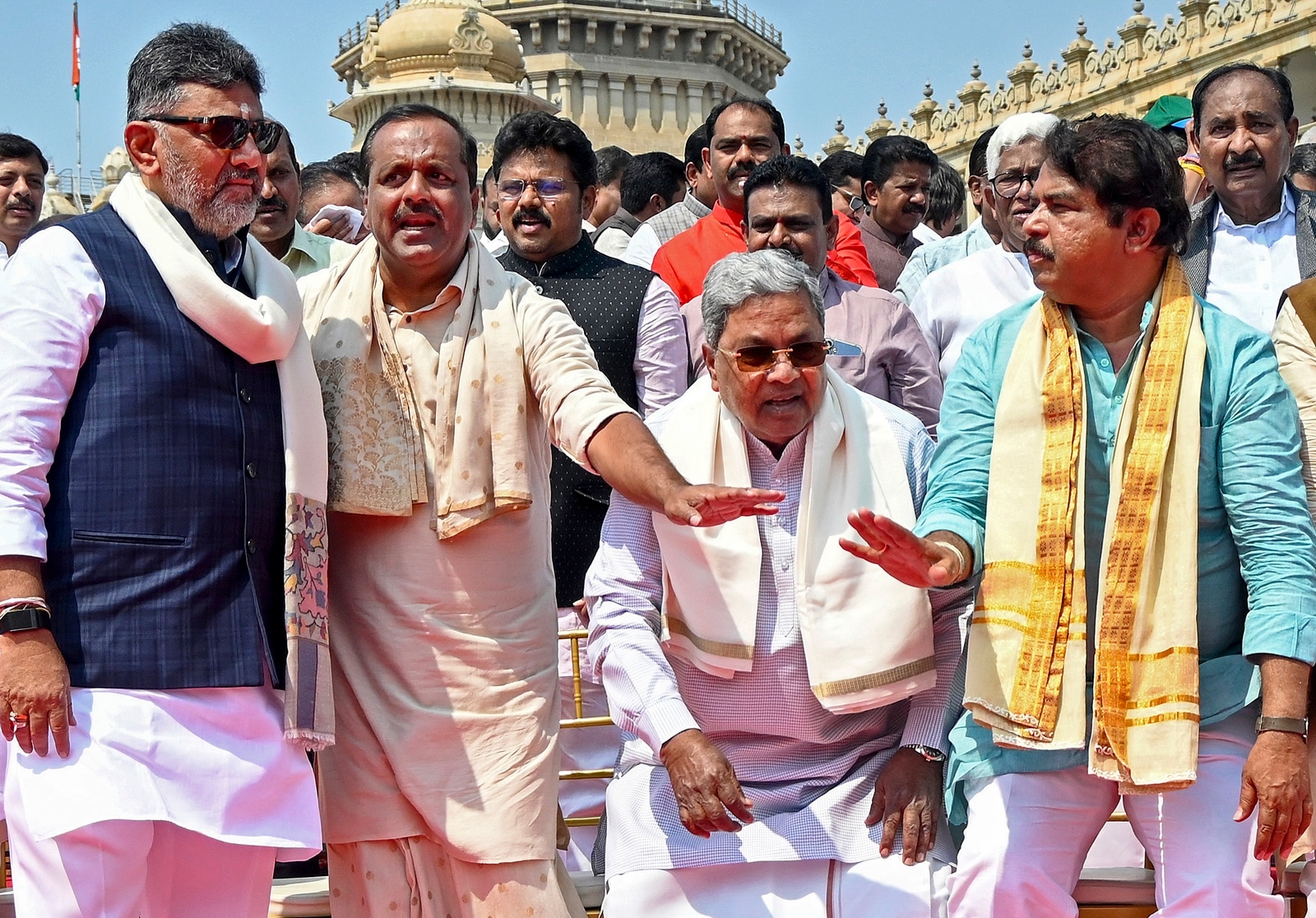 Karnataka Assembly Speaker U T Khader, CM Siddaramaiah, Dy CM D K Shivakumar, Leader of Opposition R Ashoka and others gather for a group photo outside the Vidhana Soudha in Bengaluru. (File Photo)
While those in the CM’s camp claimed there was no agreement with Shivakumar that Siddaramaiah would step aside at the halfway mark of the government — which was in November 2025 — sources close to the Deputy CM insist the “rotational formula” had been proposed by the Congress’s national leadership during talks on government formation after the 2023 Assembly polls and DK, as he is popularly known, has a “legitimate claim”.
After his repeated reminders went unheard, Shivakumar is learnt to have stopped bringing it up during meetings with the high command. “The question is not about popularity,” said a leader close to Shivakumar when asked about the argument of the CM’s supporters. “It is about a deal you have made. The promise from the leadership was that his sacrifices would not be forgotten and that he would be given a chance to lead the government. This is a man who preferred to go to jail instead of joining the BJP.”
The Deputy CM is one of the party’s few resourceful politicians and often extends his support to leaders from other states. Some Congress leaders from Assam and Kerala, who have enjoyed his backing in the past, expressed apprehension about whether he would support them in the coming April 9 elections.
Then there is the apprehension about the impact of all this on Shivakumar’s community of Vokkaligas. “The community started feeling that they are taken for granted. A drop in the Vokkaliga votes (roughly 10% of the state’s population) is a matter of concern for the Congress. It’s a challenge for Rahul Gandhi,” said a party leader.
But removing Siddaramaiah is not easy, given that he is the most popular mass leader in the state and commands a strong support among the electorate, especially Dalits and OBCs.
The bypolls will also put the Congress’s Muslim support to the test. The minority community had demanded that the Congress field a candidate from the community in Davangere South. However, the party ended up fielding Samarth Shamanur Mallikarjun, the grandson of Shamanur Shivshankarappa, whose death last December necessitated the bypoll.
BJP stuck
The BJP has failed to successfully cash in on the Congress’s shortcomings, party leaders admitted. The party has a strong base in both constituencies. Its toughest challenge will be in Davangere South, which it has not won since 2008, while in Bagalkot, it will look to avoid a repeat of 2023 when it lost to the late H Y Meti by 5,878 votes.
“The national leadership is too busy with the Assembly elections,” said an MP. Although state president and former CM B S Yediyurappa’s son B Y Vijayendra has been trying to strengthen the organisation, most of his efforts have gone unnoticed, said a leader close to him.
His supporters pointed to Vijayendra’s “connect with the youth” and acceptance among Lingayats, his community. But his critics in the party, including an MP from the state, claimed he “lacks authority” and had “failed to take everyone along”.
There is also a growing perception that the BJP, despite having 66 MLAs (as against the Congress’s 104), is not able to take up issues with sufficient intensity, giving political space to the ruling party. Internal feuds in the party have also complicated matters.
Then there is the friction with ally JD(S). Yediyurappa’s recent statement that the BJP should come to power on its own irked JD(S) leaders. After they raised it with the BJP, the former CM had to reiterate that the alliance was intact. The state BJP is also unhappy about JD(S) leader and Union Cabinet Minister H D Kumaraswamy preferring to deal with the national leadership instead of it. BJP leaders said Kumaraswamy maintains a warm relationship with Union Home Minister Amit Shah and that makes a group of state BJP leaders ensure they have cordial ties with the JD(S) leaders. Shah, according to BJP leaders, holds Kumaraswamy in high regard.