
Cometh elections, cometh welfare spending. Ahead of the Assembly elections in Assam, West Bengal, Tamil Nadu, Kerala, and Puducherry, incumbent governments have collectively announced, allocated, or disbursed over Rs 37,000 crore through new or enhanced schemes. Barring one scheme in Kerala with an outlay of about Rs 3,000 crore, all schemes were announced between January and March, weeks before the states go to polls.
If the headline numbers capture intent, the states have shown real urgency in disbursal over the past month. More than Rs 20,000 crore have been disbursed through cash doles, one-time transfers, or enhanced remunerations and pensions in the past month alone. If Tamil Nadu has disbursed over Rs 13,000 crore in March, making advance payments for existing schemes along with Pongal gifts, West Bengal has disbursed over Rs 3,000 crore in February-March. On March 10, Assam gave out Rs 3,600 crore to voters in one day.

This underlines how governments front-loaded payouts in the weeks leading up to the Model Code of Conduct (MCC), effectively advancing months of benefits into a narrow pre-election window.
Women in focus
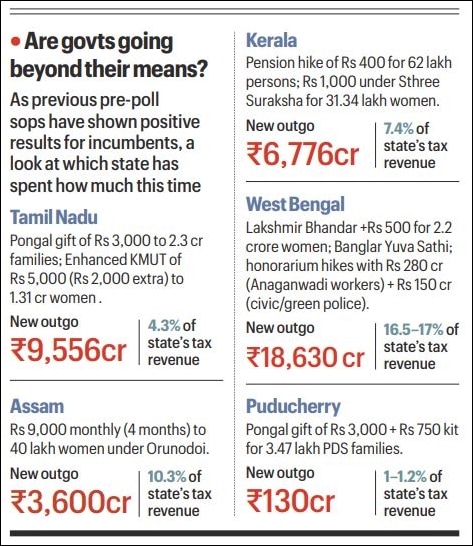
In Tamil Nadu, Chief Minister M K Stalin has built his campaign squarely around women voters. On January 4, the government announced a Rs 3,000 Pongal cash gift for each family holding a rice-category ration card, as well as for Sri Lankan Tamil camp residents, covering over 2.22 crore households. The cash component alone is estimated at Rs 6,936 crore — just over 3% of the state’s 2025–26 own tax revenue of Rs 2.2 lakh crore.
Barely a month later, the DMK government credited Rs 5,000 each to 1.31 crore women under the Kalaignar Magalir Urimai Thogai (KMUT) scheme. Of this, Rs 3,000 accounted for regular entitlements for February, March and April, while Rs 2,000 was described as “summer assistance”. The total payout stood at around Rs 6,550 crore, with the incremental component at Rs 2,620 crore. Together, the pre-poll cash infusion targeted at women this year is at least Rs 9,556 crore — around 4.3% of the state’s own tax revenue.
With women outnumbering men in a majority of constituencies, all parties have sharpened their focus on this demographic. The DMK’s earlier successes have been partly attributed to schemes such as free bus travel for women and the KMUT’s Rs 1,000 monthly transfer. With rivals like the AIADMK and actor Vijay’s TVK promising similar doles, the DMK’s latest payouts are as much about consolidating its base as they are about headline spending.
Bengal’s recalibrated welfare push
In West Bengal, the Mamata Banerjee-led Trinamool Congress (TMC) government has doubled down on its flagship Lakshmir Bhandar scheme. The February 2026 interim Budget raised monthly assistance by Rs 500, taking it to Rs 1,500 for general category women and Rs 1,700 for SC/ST beneficiaries.
With 2.2 crore women covered, the hike alone will cost about Rs 13,200 crore annually. The Budget also introduced Banglar Yuva Sathi, offering Rs 1,500 per month to unemployed youth aged between 21 and 40, who have cleared Madhyamik, with an initial allocation of Rs 5,000 crore.
Additional commitments include Rs 1,000 monthly honorarium hikes for Anganwadi workers and helpers (Rs 280 crore) and for civic volunteers and Green Police (Rs 150 crore). Together, Bengal’s incremental pre-poll welfare commitments total roughly Rs 18,600 crore — about 16.5–17% of its own tax revenue, the highest among the five states.
Launched in 2021, Lakshmir Bhandar played a key role in the TMC’s victory in the last election, particularly among women voters. The latest hike now forms the centrepiece of the party’s 2026 pitch, framed as evidence of continued delivery despite alleged fund constraints from the Centre.
Assam, Kerala, and Puducherry
In Assam, the BJP is banking on its Orunodoi scheme to replicate Bengal’s welfare success. On March 10, just ahead of polling, the government credited Rs 9,000 each to around 40 lakh women, combining four months’ instalments with a Bohag Bihu top-up.
The one-day transfer amounted to Rs 3,600 crore — over 10% of the state’s annual own tax revenue of Rs 34,823 crore. Women-centric direct benefit transfers have previously helped blunt voter anger over unemployment and inflation, and the scale and timing of this payout underline their centrality to the BJP’s strategy.
Kerala’s Left government has opted for a more institutional approach, but with a similar political calculus. In October 2025, it raised social security pensions from Rs 1,600 to Rs 2,000 per month, benefiting around 62 lakh elderly, widows and disabled persons. The Rs 400 hike implies an additional annual burden of about Rs 2,976 crore.
The state has also launched Sthree Suraksha, a new Rs 1,000 monthly pension for economically vulnerable women and trans women aged 35-60 not covered under existing schemes. With a target of 31.34 lakh beneficiaries, the scheme is expected to cost about Rs 3,800 crore annually.
The first instalments were credited on February 11 to just over 10 lakh beneficiaries. Together, the pension hike and new scheme amount to commitments of roughly Rs 6,776 crore — around 7.4% of Kerala’s own tax revenue. For a government criticised over fiscal stress and delayed payments, the message is clear: welfare will not be rolled back.
Even Puducherry, with a much smaller fiscal base, has followed the same template. In mid-January, the government in the Union Territory approved a Rs 3,000 Pongal cash gift for 3.47 lakh PDS families, along with a commodity kit worth Rs 750.
The cash component amounts to about Rs 104 crore, with the total package touching roughly Rs 130 crore — around 1–1.2% of its annual receipts.
Welfare as a poll strategy
Across these states, welfare is no longer a supplementary campaign tool. It is the campaign.
An October 2025 analysis by The Indian Express of eight major state elections between 2023 and 2025 found that governments had disbursed Rs 67,928 crore in pre-poll welfare. Bihar alone accounted for Rs 19,333 crore — 32.48% of its own tax revenue — in the run-up to elections.
It showed how ruling alliances in Maharashtra and Bihar relied heavily on last-mile cash transfers to blunt anti-incumbency and return to power, echoing earlier patterns in Madhya Pradesh and Jharkhand.
Whether this strategy will again offset concerns over unemployment, inflation, and governance will only become clear on May 4 when the votes are counted. For now, the numbers tell their own story: from about 4% of own tax revenue in Tamil Nadu to over 16% in West Bengal and more than 10% in Assam, incumbents are committing an ever larger share of their finances to welfare, betting that cash in hand will translate into votes at the ballot box.