
The West Bengal Assembly elections might be just less than a month away, but amid concerns created by the Special Intensive Revision (SIR) process, migrants from Bengal across the country are trying to make their way to the state. From a construction worker in Mumbai and a banker in Pune to a cook in Bengaluru and workers in Gujarat, The Indian Express spoke to over a dozen such migrants.
In Mumbai’s busy Chhatrapati Shivaji Maharaj Terminus, people from Bengal waiting to catch a train complained about the lack of special trains to meet the high demand during the election season. Many like Asif Ashraf, a domestic helper on his way to Kolkata, are banking on unreserved tickets. “I tried booking tickets a month in advance, but to no avail. Now, I hope to get a seat with an unreserved general ticket,” he said.

Brothers Sumodh and Suraj Das said they too tried to book tickets when the election dates were announced, but the waitlist had surpassed 100-150. “Instead, we chose to purchase a ticket in the general coach,” they said. Construction worker Jayanto Bagdi, who is from Purba Bardhaman district, wondered why the government had not deployed special trains as it did during the Covid-19 lockdown.
The lack of train tickets and, in some cases, inflated costs, is proving to be an obstacle for many in other parts of the country, too. Bengaluru resident Reema, who works as a cook, said the “unrelenting electoral process” — she went to Bengal last month for the SIR — was proving to be a financial challenge. “Train tickets are nearly Rs 4,000 one way, buses are Rs 4,000-Rs 5,000. I have my husband and child, how can we afford it? Flights will cost Rs 10,000 to Rs 12,000, almost half our salary,” she said, urging the authorities to arrange for special buses or trains.
All India Shramik Swaraj Kendra’s national vice-president R Kaleem Ullah said more than three lakh workers from Bengal were engaged in various sectors in Karnataka, most of whom cannot afford the steep travel costs. “The Central and state governments must take responsibility to provide Shramik trains and sleeper buses,” he said.
A similar scene is unfolding in Ahmedabad, too. At the city gold market, Samast Bengali Samaj Association president Abdul Rauf Yakub Shaikh said there was a “mighty rush” for tickets in the second half of April. “But there simply aren’t enough tickets and so we are hoping the government introduces special trains between Ahmedabad and Howrah to accommodate the rush … We are also helping them (migrants) by arranging buses, at least for the bachelor workers, who want to start leaving earlier,” he said.
Trinamool Congress (TMC) spokesperson Arup Chakraborty claimed the party was not making any organised effort to rent trains and bring over migrants, saying the BJP-led Centre would scotch any such attempt. But, a senior party leader in Murshidabad, which is a migrant hub, said initiatives to bring voters back to the state would begin closer to the polls. “If we try to bring the migrants over now, many will not agree since they will lose days of wages,” he said.
The shadow of SIR
For many migrant workers, the rush back home is fuelled by the concern and anxiety generated by the long-drawn-out SIR process, with many looking forward to voting this time, as it is tied to the perception that not being able to exercise their franchise may lead to problems down the road. Last year, several migrant workers from Bengal were detained and faced harassment in various states across the country after being labelled as Bangladeshis. Many were pushed across the border into Bangladesh as part of a drive against undocumented immigrants.
In its aftermath, Chief Minister Mamata Banerjee announced the Shramshree scheme under which every migrant family was eligible to receive Rs 5,000 per month for a year on their return to the state.
“My name was deleted in the SIR first phase. Subsequently, my father attended an SIR hearing, as I am in Pune, following which my name has been included in the electoral rolls. Now, I want to vote to confirm it,” said Shibayan Sett, a banker.
Loton Mandal from Purba Medinipur who works at a local restaurant in Pune said that though he had voted in every election till now, “this time it is especially crucial”. “I am not very educated, but I follow the news from Bengal. Everybody is saying that these elections are very important. I have had no problems with SIR, but people around me are saying that if we don’t vote, there might be problems in future. It might be difficult for my children.”
Like Mandal, Robin Handol, who also works in a Pune restaurant, believes this is “more than just an election”. “Since my parents’ death, there is nobody at home in Bengal. But I have decided to go and vote so that there is no problem (with citizenship) in future,” he said. Given the steep airfare, Handol has decided to take a train to Bhubaneswar and then travel by bus to his home in Medinipur.
In Bengaluru, migrant labourer Mohammad Shaikh said of his 12 siblings, only six had managed to retain their names on the electoral rolls. “If we don’t vote now, we fear our names may not appear in the next election,” he said.
The Samast Bengali Samaj Association’s vice president Sujeet Banerjee, who runs a gold testing business in Ahmedabad, said many workers who had returned after the SIR exercise want to go back as they fear their Voter IDs may get “cancelled” if they do not vote in the coming elections. “We are trying to spread awareness that the Voter ID cannot be cancelled, but there is fear and uncertainty among the workers,” he said.
However, for those like Bipul Roy, who has been living in Chandigarh for the last 16 years but is a registered voter in Kolkata, the SIR is a “necessary exercise to remove ineligible voters from electoral rolls”. “West Bengal is developed, but illegal migration from Bangladesh has become a major concern. A change in government may help control this,” said Roy, who runs a private health clinic.
Economic impact
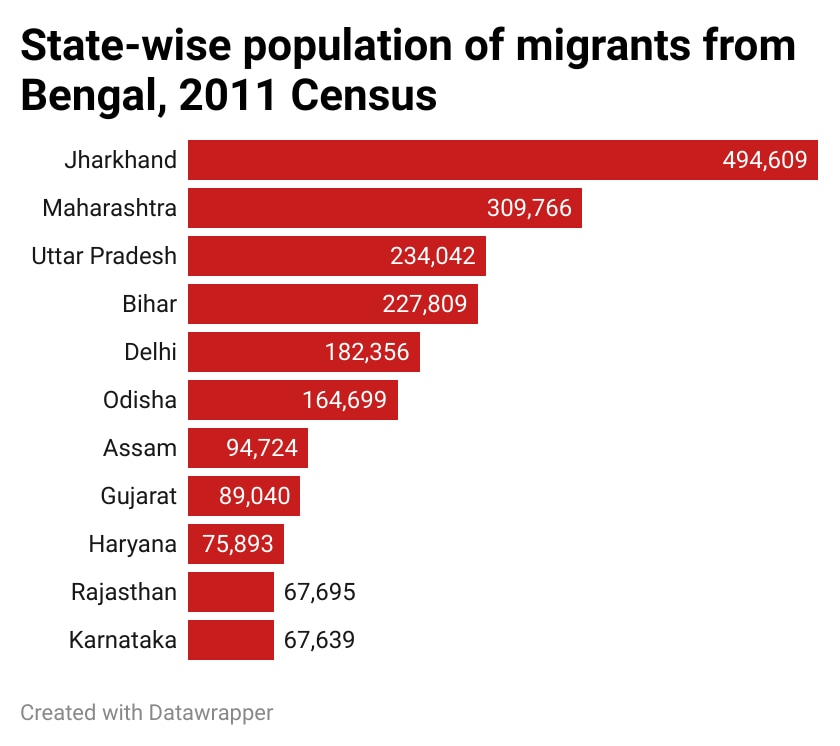
There were 24.06 lakh migrants from Bengal across the country, as per the 2011 Census, with Jharkhand (4.95 lakh), Maharashtra (3.1 lakh), Uttar Pradesh (2.34 lakh), and Bihar (2.28 lakh) among the top destinations. The number of Bengal migrants in Gujarat was 89,040, the data showed.
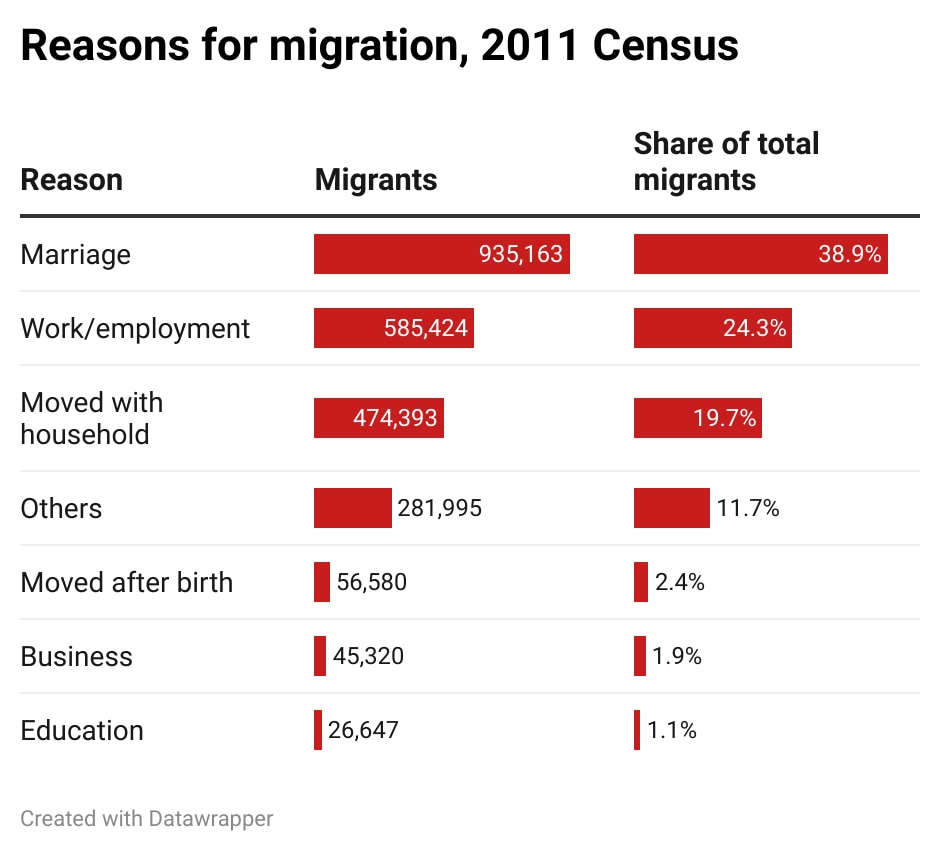
The railways are a major conduit for the movement of migrants, both in and out of the state. Owing to the large scale of migration, it is often difficult to reserve tickets for Bengal-bound states round the year. In a 2024 report, the Economic Advisory Council to the Prime Minister (EAC-PM) analysed unreserved (general) class data for non-suburban passengers (150+ km travel) for 2023. Among the cheapest tickets available, this was a proxy for blue-collar migrants.
In this report, West Bengal features as one of the key migrant states. According to it, Howrah district is the number three destination of trains, while Paschim Bardhaman and Murshidabad are among the top 10 origin districts for the movement of non-suburban passengers.
With the migrant workers returning to Bengal — not only because of the elections but also due to the LPG shortage caused by the West Asia conflict — many of the local industries where they play an integral role are facing a labour crunch.
In Gujarat, Gems and Jewellery Export Promotion Council’s (GJEPC) former state chairman, Vijay Mangukiya, said the absence of Bengali workers had “exponentially affected” production. “Presently, the diamond-studded jewellery market is not running well due to the geopolitical situation. Even if the artisans stay in the city, we still have to provide them with work and a salary, which would be a financial burden on the company.”
Surat Embroidery Association president Karunesh Ranperiya said he was running only three of his 10 embroidery machines and that business was down by nearly 70% because workers had returned to Bengal.
Biswajit Khatua from Medinipur, who has been living in the old city of Surat with his wife and two children for the past 26 years, said there was a recession in the diamond jewellery business both nationally and internationally. “Our income has gone down, and it is difficult for us to survive here. My children’s exams are over, so we booked tickets three months ago. Though my tickets are not confirmed, we are working on it. We will return to Surat after a month, as we hope that by then the jewellery business will have normalised,” he said.
The absence of workers has also created a problem in the fields of Punjab, as many who went back to Bengal for the SIR did not return in time for the potato harvesting season that runs from January to mid-March. This has led to many farmers in the potato belt of Jalandhar and Kapurthala to suffer losses. Several labourers rushed back home in Bengal to ensure their names were on the voter list, afraid of the consequences of missing out on voting rights.
— With inputs from Dipanita Nath and Ajay Jadhav in Pune, Jagpreet Singh Sandhu in Chandigarh, Anju Agnihotri Chaba in Jalandhar, Ravik Bhattacharya in Murshidabad, and Dheeraj Mishra and Anjishnu Das in New Delhi