
The forthcoming Assembly polls in West Bengal once again appear to be polarising the electorate on communal lines, albeit through a somewhat altered vocabulary. If the 2021 election saw the electorate sharply divided over the Citizenship Amendment Act (CAA) and the prospect of a National Register of Citizens (NRC), the current political discourse is coalescing around the Election Commission’s (EC) Special Intensive Revision (SIR) of electoral rolls, alongside familiar themes of “infiltration” and “minority appeasement”.
In a state where Muslims constitute over 27% of the population as per the 2011 Census, minority-dominated districts in Bengal are once again likely to be pivotal to the electoral outcome. Data from the 2021 polls — arguably the most communally polarised in the state in decades — suggest that such polarisation worked decisively in favour of the Trinamool Congress (TMC).

In the nine districts where Muslims account for more than 25% of the population — Murshidabad, Malda, Uttar Dinajpur, Birbhum, South 24 Parganas, Nadia, Howrah, North 24 Parganas and Cooch Behar — the TMC won 127 of 160 seats, a strike rate of nearly 80%. The BJP secured 32 seats, half of them from just two districts — Cooch Behar and Nadia.
In contrast, in the remaining 14 districts where the Muslim population is below 25%, the TMC’s strike rate dropped, even though it maintained a comfortable lead over the BJP. Here, the party won 86 of 134 seats (64%), while the BJP took 47. These districts include Bardhaman, Paschim Bardhaman, Kolkata, Hooghly, Purba Medinipur, Jalpaiguri, Alipurduar, Paschim Medinipur, Jhargram, Bankura, Purulia, Darjeeling, Kalimpong and Dakshin Dinajpur.
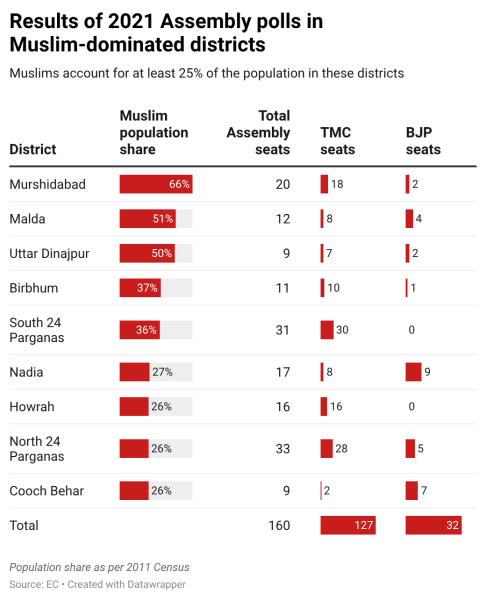 2021 Assembly poll results in minority-dominated districts.
The TMC combined welfare delivery, Bengali regionalism and strategic candidate selection to register a dominant victory — winning 213 of 294 seats with a vote share of 48% in the 2021 polls. Chief Minister Mamata Banerjee also sustained a women-centric political image, foregrounding schemes such as Kanyashree and Rupashree while fielding a relatively higher proportion of women candidates — factors that helped consolidate female voters cutting across communities.
A comparison between the 2016 and 2021 polls shows that the TMC reduced the number of Muslim candidates from 54 to about 45, particularly in constituencies where the BJP had performed strongly in the 2019 Lok Sabha elections. This indicated an attempt to blunt the BJP’s “minority appeasement” charge, even as the party relied on Muslim voters to back it irrespective of candidate religion.
The TMC was further aided by the complete collapse of the Left and the Congress, neither of which won a single seat, leading to an almost total consolidation of minority votes in its favour. Its dominance was underlined by the narrow margin map as well — only 12 seats across the state were decided by less than 2,000 votes, nine of which were won by the BJP.
Against this backdrop, the BJP appears to be recalibrating its approach ahead of the 2026 polls. Its rhetorical strategy suggests measured moderation without dilution of its core polarising pitch, in contrast to the far more overt, high-decibel communal mobilisation of 2021.
In the run-up to the 2021 Assembly election, Union Home Minister Amit Shah had explicitly tied citizenship to religious identity and migration. His campaign repeatedly invoked CAA-NRC through the “chronology samajhiye” formulation, outlining a sequence in which non-Muslim refugees would be granted citizenship while “infiltrators” would be identified and removed. He had also described illegal Bangladeshi migrants as “termites”, a remark that came to symbolise the BJP’s sharper, more direct communal framing at the time. This was reinforced on the ground by leaders such as Suvendu Adhikari, whose messaging often leaned on explicit Hindu-Muslim binaries.
In the current cycle, however, Shah’s language has shifted towards a more policy-framed articulation of similar concerns — declaring that the days of “appeasement politics” in Bengal are over while criticising the West Bengal government for not cooperating on border fencing. The emphasis is less incendiary, but the underlying themes remain intact.
“Appeasement politics of the TMC and infiltration remain key issues in West Bengal. We can feel the resonance of the issues on the ground. We also know this will lead to the downfall of the TMC. In the last polls, overt polarisation helped us, but also hurt us. We want these polls to be both about appeasement and misgovernance of the TMC,” a BJP leader from the state said.