
While the campaigning is yet to get underway in the poll-bound states of Tamil Nadu, Kerala, West Bengal and Assam, the incumbent governments there are already pushing the Direct Benefit Transfer (DBT) schemes as part of their election messaging. Their measures include expansion of existing programmes through the final Budgets as their terms come to an end.
While the popularity of the DBT programmes is a constant across these states, their financial health differs widely.

Most recently, in mid-February, the Chief Minister M K Stalin-led DMK government in Tamil Nadu made a splash with its surprise transfer of Rs 5,000 each into the accounts of 1.31 crore women under the Kalaignar Magalir Urimai Thogai scheme, which grants Rs 1,000 per month to women heads of families. Coming at a cost of Rs 6,550 crore, though the announcement prompted rival parties’ charges of “electoral opportunism”, it did not stop the principal Opposition AIADMK from one-upping the DMK and promising women heads of families Rs 2,000 a month, besides a one-time transfer of Rs 10,000 to every state household.
But behind these cash transfers and promises, which have increasingly featured in Assembly elections and been credited with securing victories in several states — from Maharashtra to Bihar — are precarious fiscal conditions and rising debts of some of them.
Tamil Nadu
In its latest Budget, the last before the Assembly elections, the DMK government raised spending on all welfare schemes from Rs 92,692 crore in 2025-26 to Rs 98,857 crore in 2026-27, spiking the government’s outstanding liabilities from Rs 9.7 lakh crore to Rs 10.99 lakh crore.
Among the notable welfare schemes are the Kalaignar Magalir Urimai Thogai scheme, for which the government allocated Rs 14,412 crore in 2026-27, marginally up from Rs 13,807 crore in 2025-26. Other key direct transfers include discounted power tariffs (costing Rs 7,641 crore in 2026-27), free bus travel for women (Rs 4,000 crore), and house construction grants (Rs 1,500 crore). The state also allocated Rs 5,463 crore for all social security pensions.
But even with the state’s social sector expenditure accounting for 34.4% of total disbursements in 2026-27 and overall outstanding debt hitting 26.35% of the state GDP, Tamil Nadu has been able to generate revenues on its own rather than rely on transfers from the Central government.
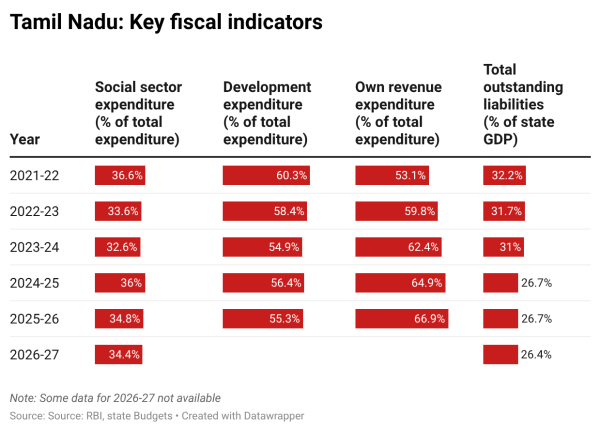
At 66.9%, most of Tamil Nadu’s revenue expenditure comes from funds raised by the government itself and 55.3% of its spending was on developmental expenditure, which is aimed at long-term economic growth and improving infrastructure or social services. While its own revenue expenditure remains above the all-India average of 57.3%, its developmental expenditure falls below the national average of 62.8%. However, the share of developmental expenditure has dropped over the course of the last five years.
Tamil Nadu’s non-developmental expenditure, which covers operational costs including government salaries, accounted for 29.5% of total spending.
However, among the causes for concern are Tamil Nadu’s internal debts growing at one of the fastest rates in the country, as per a Comptroller and Auditor General (CAG) analysis of states in 2023-24, and the state continuing to miss the targets for revenue and fiscal deficits set by the Fiscal Responsibility and Budget Management (FRBM) Act. While its debt-to-GDP ratio remains above the FRBM’s 20% target at 26.35%, it remains among the fiscally healthier states in the country. In 2021-22, the debt-to-GDP ratio had peaked at 32.2% and has since consistently declined.
Kerala
Though the 2026-27 Kerala Budget has directed its outreach on increasing the wages and honorariums of ASHA, Anganwadi and government school workers besides committing to paying pending Dearness Allowance dues, the CPI(M)-led Left Democratic Front (LDF) government has allocated Rs 21,077 crore to welfare programmes, up from Rs 15,963 crore in 2025-26.
While the government is set to spend Rs 14,500 crore on social security pensions alone (an increase from Rs 11,000 crore in 2025-26), one of its key welfare programmes is the Chief Minister’s Stree Suraksha Padhathi, which grants Rs 1,000 per month to women aged 35 to 60 years from low-income households. After announcing the scheme in late 2025, the government has gone on to allocate Rs 3,720 crore in the 2026-27 Budget, making it one of the largest welfare outlays this year.
As a result of these additional expenses, the state’s outstanding debt has risen to Rs 5.45 lakh crore in 2026-27, up from Rs 4.89 lakh crore.
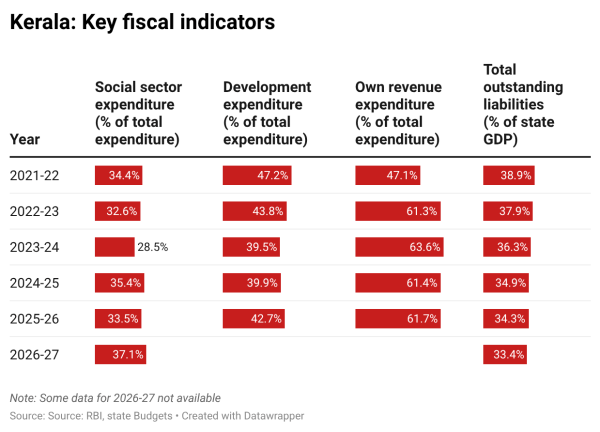
Though the state’s rising own-revenue expenditure, up to 61.7% in 2025-26 from 47.1% in 2021-22, is a positive trend, its outstanding liabilities remain well above the FRBM Act target of 20%, at 33.44% in 2026-27 despite declining every year since 2021-22. As per a NITI Aayog report from 2022-23, while Kerala has been successful in mobilising revenues from within the state, it has struggled to raise its capital expenditure given the heavy burden of its social sector and non-developmental spending.
West Bengal
In West Bengal’s 2026-27 Budget, the ruling Trinamool Congress (TMC) government allocated Rs 1.8 lakh crore to welfare programmes, raising the monthly grant to women from poor households under the flagship Lakshmir Bhandar scheme from Rs 1,000 to Rs 1,500, and announcing the Banglar Yuva Sathi scheme to grant Rs 1,500 per month to unemployed people aged 21 to 40 years.
This year, the government allocated Rs 26,700 crore for the Lakshmir Bhandar scheme, up from Rs 17,076 crore, while also allocating Rs 5,000 crore for the Banglar Yuva Sathi programme. Among the other notable welfare schemes are the Jai Johar and Taposili Bandhu pension schemes to grant Rs 1,000 per month to elderly citizens from the Scheduled Caste and Scheduled Tribe communities, which was allocated Rs 2,027 crore. The Krishak Bandhu income support programme, which gives farmers Rs 5,000 per acre per year, was allocated Rs 6,763 crore.
As a result, the state’s social sector spending has risen to 52% of total expenditure, while its outstanding debts have risen to more than Rs 8 lakh crore, prompting the government to finance its expanded schemes with a loan of Rs 1 lakh crore. Five years ago, the state social sector spending had stood at 48.3% of all expenditures, while its outstanding liabilities had just breached the Rs 5 lakh crore mark.
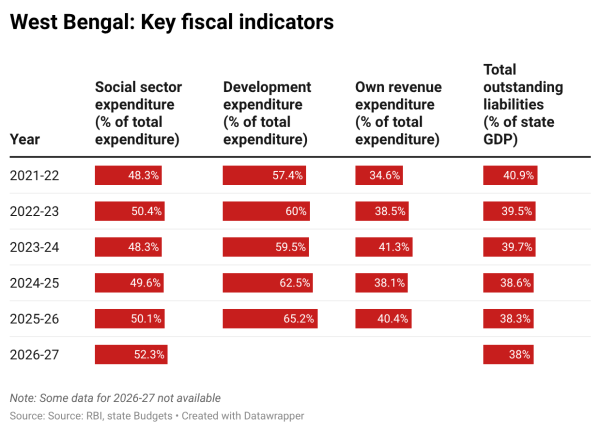
Though the state’s developmental expenditure has risen from 57.4% of all spending in 2021-22 to 65.2% in 2025-26 (the latest available data), its own-revenue expenditure as share of all spending has risen from 34.6% to 40.04% in the same period, well below the all-India average of 57.3% in 2025-26. Bengal’s own-revenue expenditure share trails even poorer states like Uttar Pradesh, Jharkhand and Chhattisgarh.
The state’s outstanding liabilities came down to 37.98% in 2026-27 from 40.9% in 2021-22, though it remains above the FRBM target of 20%. West Bengal’s high debt means its annual interest payments are among the highest in the country, as per a CAG analysis, though its internal debt has grown at among the slowest rates in the country over the past decade. The state’s debt position has, however, contributed to restricting its capital expenditure in recent years.
Assam
The BJP-led Assam government, as part of its Rs 2.63 lakh crore Budget for 2026-27, has included a range of welfare grants, including Rs 2,500 per month to graduates of state universities, a one-time aid of Rs 50,000 each to 6.8 lakh tea garden workers, a further Rs 250 subsidy for the Centre’s Ujjwala programme for LPG cylinders, and Rs 1,250 per month each to ration card-holding families under the flagship Orunodoi scheme.
Late last year, while launching a new scheme for monthly subsidised rations, Chief Minister Himanta Biswa Sarma said eligible families could receive up to Rs 5,000 in government assistance each month under a slew of welfare programmes.
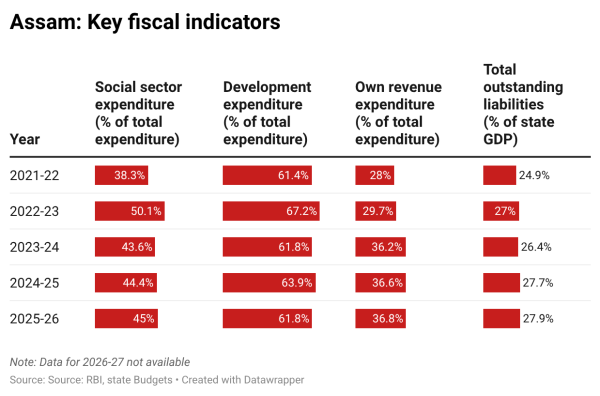
Though the detailed Budget documents have not yet been published by the Assam government on its website, data from the previous five years show that while social sector spending and developmental expenditure have remained largely stable and matched national averages in 2025-26, the state has struggled to raise its own revenues to finance that expenditure. Assam own-revenue expenditure as a share of total spending was 36.8% in 2025-26, below the all-India average of 57.3%.
More troubling is the state’s outstanding liabilities as a share of its GDP. From 24.9% in 2021-22, it has risen to 27.9% in 2025-26, well above the FRBM target of 20% but still among the lowest in the country. However, as per a CAG analysis of states in 2023-24, Assam had the fastest growing internal debt over the past decade and saw its overall loans also rising at among the highest rates.
|
State’s outstanding debts as a share of its GDP |
||||
|
Year |
Tamil Nadu |
Kerala |
West Bengal |
Assam |
|
2021-22 |
32.2 |
38.9 |
40.9 |
24.9 |
|
2022-23 |
31.7 |
37.9 |
39.5 |
27 |
|
2023-24 |
31 |
36.3 |
39.7 |
26.4 |
|
2024-25 |
26.65 |
34.87 |
38.57 |
27.7 |
|
2025-26 |
26.69 |
34.26 |
38.29 |
27.9 |
|
2026-27 |
26.35 |
33.44 |
37.98 |
|
|
Note: 2026-27 data not available for Assam |
||||
|
Source: RBI, state Budgets |
||||