
(As West Bengal gears up for the Assembly polls, every Tuesday, The Indian Express’s Kolkata bureau chief Ravik Bhattacharya decodes the electoral trends, political signals, and campaign moves shaping the contest.)
Five years after failing to deal a body blow to the Trinamool Congress (TMC) despite registering its best Assembly election result, the BJP is gearing up for another Bengal campaign, but it still appears to be an uphill task for a party that either rules or is part of the ruling coalition in 21 states and Union Territories.

Though factors such as anti-incumbency, alleged corruption, and unemployment appear to be factors working against the Mamata Banerjee-led TMC, the BJP has to overcome multiple challenges if it has to win Bengal, which is something the party covets the most. A win will fulfil the BJP’s ideological need, mark the vanquishing of Banerjee who has emerged as one of the ruling party’s toughest opponents, limited though she is to just one state.
Organisational challenges
During the recently concluded Special Intensive Revision (SIR) of electoral rolls, the BJP appointed 35,651 Booth Level Agents (BLAs), while there are more than 80,000 booths. The party, in short, does not have a pan-Bengal organisational presence, something which it has blamed on the TMC’s violence since the post-election days in 2021. BJP leaders have also alleged that a large section of its workers are slapped with false police cases.
However, despite its weaknesses, the BJP has held on to its vote share. In 2021, the party won 77 out of 294 seats with a vote share of 38.15%. Three years later, it suffered a setback in the Lok Sabha polls as its tally fell from 18 to 12, but its vote share was a healthy 39.08%.
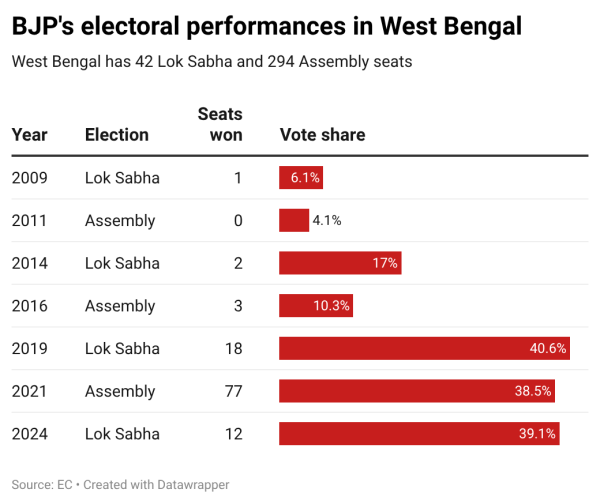
One major problem for the BJP has also been rampant factionalism, something that Union Home Minister Amit Shah, while on a visit in January, directed the state unit to end. Since then, it appears to have closed ranks behind new state president Samik Bhattacharya. Bhattacharya appears to have largely managed to unify the party rank and file. At the moment, Leader of Opposition Suvendu Adhikari, Union Minister Sukanta Majumdar, state chief Bhattacharya, and former state president Dilip Ghosh, who has made a return since Shah’s January visit, appear to be working without any hitch as of now.
The party on March 1 launched its Parivartan yatra, a major campaign push that will see the party host 63 mega rallies and cover 5,000 km, with all this culminating in a public rally by Prime Minister Narendra Modi at Kolkata’s Brigade Parage Grounds. On March 2, Amit Shah, Defence Minister Rajnath Singh, Union Environment Minister Bhupendra Yadav, Union Agriculture Minister Shivraj Singh Chouhan, and Maharashtra CM Devendra Fadnavis were also in the state to flag off Parivartan Yatras. With this, the BJP hopes to galvanise its cadre and paper over differences in the state unit.
Removing ‘outsider’ tag
One of the BJP’s biggest challenges is nullifying the “outsider” tag that the TMC managed to successfully make stick five years ago and is trying to do again this time. The TMC has jumped on BJP leaders’ faux pas when commenting on Bengali icons and the party-led Bihar government’s recent decision to restrict meat and fish sales.
Overcoming this narrative that the BJP is “anti-Bengali” is one of the tests, and under Bhattacharya, there has been an evident shift. While “Jai Shri Ram” was the battle cry in 2021, this time the party has made a shift towards Bengali Gods and Goddesses. In a recent open letter to the voters of Bengal, PM Modi started with “Joy Ma Kali.” The party has also asked leaders from outside the state to be careful while making statements about Bengali icons.
The Mamata Banerjee factor
The state BJP does not yet have a leader of the stature of Mamata Banerjee and, in the absence of a face, it has asked its workers and leaders not to make personal attacks against the CM during the campaign.
The CM has not only managed to galvanise the TMC rank and file by taking the lead in the protests against the SIR — she is expected to hold a dharna in Kolkata, and the optics of her standing in the Supreme Court, arguing the case for people has put the BJP on the defensive — the TMC government’s dole politics has also given the ruling party the edge. The CM, in the recent budget, announced a hike for popular welfare schemes such as Lakshmir Bhandar and the Yuva Sathi (for unemployed youth).
To counter Mamata’s dole politics, Amit Shah has promised the implementation of the 7th Pay Commission for state government employees within 45 days of the BJP coming to power; fill all vacant government posts, including teachers, by December 26; and a special financial allocation of Rs 5,700 crore to empower women.
The BJP also understands that apart from women’s vote, the Muslim vote is crucial for the TMC’s chances of winning the fourth straight election. However, certain sections of Muslims are unhappy with the TMC over changes in the state OBC list and the implementation of the Waqf law. With the emergence of a smaller party such as the Jatiya Unnayan Party formed by suspended TMC MLA Humayun Kabir, and amid Congress’s attempts to position itself as a viable option for voters in Murshidabad and Malda, the BJP is hoping for even a slight dent in the TMC’s Muslim vote bank.
EC and SIR
The BJP is banking on the Election Commission (EC) ensuring a strict voting process so that the TMC cannot engage in what it alleges are “proxy voting and intimidation tactics”. With over 63 lakh names (of dead voters and those who have migrated) deleted, the BJP believes it will have the edge as the ruling party won’t have “bogus voters” to fall back on.
With a significant chunk of over 60 lakh voters placed “under adjudication” coming from districts with a significant Muslim population, the TMC unease is expected to increase. Data accessed by The Indian Express show a high number of cases pending adjudication in Murshidabad (11.01 lakh), Malda (8.28 lakh), South 24 Parganas (5.22 lakh), North 24 Parganas (5.91 lakh), Howrah (2.89 lakh), and Uttar Dinajpur (4.8 lakh).
However, the BJP also has to deal with the SIR fallout in the Matua belt — in North and South 24 Parganas and Nadia — that powered its rise in the state, as well as the deletions in Scheduled Caste communities in north Bengal where it has the organisational network to take on the TMC.