
A cash-strapped West Bengal government, already reeling under a debt of more than Rs 8 lakh crore, has announced a 4% hike in the dearness allowance (DA) for government employees even as the Trinamool Congress-led administration remains on the hook for pending dues from 2008 to 2019 and expects to fund expanded social schemes with another loan of Rs 1 lakh crore.
The Mamata Banerjee government tabled the vote-on-account, or the interim Budget, on Thursday, even as the Supreme Court directed it to pay 25%, or an estimated Rs 10,400 crore of the total pending amount from 2008 to 2019 by March 31.

Presenting the vote-on-account, state Finance Minister Chandrima Bhattacharya said the 4% DA hike would amount to an additional financial burden of Rs 750 crore, with the total Budget outlay at Rs 4 lakh crore in 2026-27. However, the government made no provisions for the pending DA dues.
With the vote-on-account putting the revenue deficit for 2026-27 at Rs 21,759 crore, the state has recorded a decline from previous years. Revenue deficit is the excess of revenue expenditure over its revenue receipts, which leads to deficit financing through borrowing.
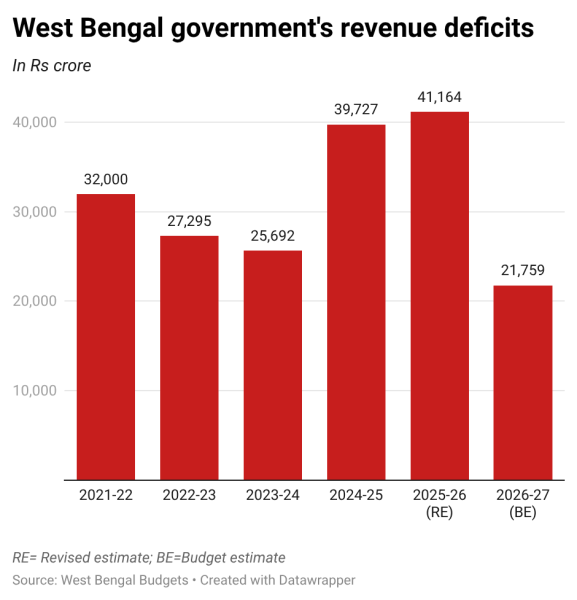 Revenue deficits since 2021-22
While in 2024-25, the actual revenue deficit was Rs 39,727 crore, the figure rose to Rs 41,164 crore in 2025-26 as per the revised estimates. But the Supreme Court’s decision, finance department officials said, could raise the 2026-27 revenue deficit to nearly Rs 32,000 crore.
While the revenue deficit figures have remained high, the government’s outstanding debt has been rising every year. In 2024-25, the state government’s outstanding debt stood at Rs 6.99 lakh crore, which rose to Rs 7.62 lakh crore in 2025-26 (revised estimates), and further to Rs 8.15 lakh crore in 2026-27.
The DA hike and its added costs to the exchequer are among the several programmes expanded through the vote-on-account. While Rs 40,000 crore has been allocated for the flagship Lakshmir Bhandar scheme, which will grant an additional Rs 500 per month to women from poor households, another Rs 40,000 crore will go to the Banglar Bari scheme to provide housing for poor families.
The state government has already spent Rs 74,000 crore over the first 50 months of the Lakshmir Bhandar scheme, benefitting 2.2 crore women who each received Rs 1,000 per month (SC and ST women received Rs 1,200 per month). Under the Banglar Bari scheme, families were given Rs 1.2 lakh each to build pucca houses, with the government announcing last month that another 32 lakh houses would be built over the next two months, in addition to the one crore homes already built.
The government has said it will also spend more than Rs 10,000 crore on a range of other social welfare schemes, including Rs 2,000 crore for the Mahatmashree scheme, which is the state’s own rural employment guarantee scheme that was renamed from Karmashree in response to the Centre renaming the Mahatma Gandhi National Rural Employment Guarantee Scheme to Viksit Bharat – Guarantee for Rozgar and Ajeevika Mission (Gramin) or VB-G RAM G.
As per the 16th Finance Commission report for the period 2026-2031, which was tabled in Parliament along with the Union Budget, Bengal is among the most indebted states in India. Figures from 2023-24 show that Bengal, with a debt-to-GDP ratio of 38.3%, is second only to Punjab at 42.9%. This raises questions about its ability to finance its welfare programmes and the DA hike, and fulfil the top court’s directives.
As for the state government’s sources of revenue, the largest chunk will come from the State Goods and Services Tax (SGST) at an estimated Rs 56,279 crore, with state excise taxes contributing Rs 24,200 crore and sales taxes Rs 13,976 crore. The state’s share of taxes collected by the Centre amounts to Rs 1.09 lakh crore. In total, the state’s revenue receipts have risen from Rs 2.45 lakh crore in 2025-26 to Rs 2.88 lakh crore in 2026-27.
What the experts say
However, Amit Mitra, the Principal Chief Adviser to the CM and a former state finance minister, maintained that the government’s fiscal health remains on target. “We have reduced the revenue deficit from 3.75% (of the state GDP) when Chief Minister Mamata Banerjee took over. From 3.75%, today we are at 1.01%. And our destination is towards zero – the art of the possible, step by step.”
Economist Saikat Sinha Roy, a former head of the Economics Department at Jadavpur University, was sceptical of the government’s ability to fund its expenditure. “The proposed increase in allocations for schemes like Lakshmir Bhandar and DA hike, among other expenditures, and pressure from the Supreme Court to pay the DA arrears, are definitely going to increase the fiscal burden on the state. The state has not been able to meet the revenue expenditure target as per the FRBM Act in the recent past,” Roy said, referring to the Fiscal Responsibility and Budget Management Act, 2003, which sets deficit limits and debt targets.
“The debt burden of the state, which is alarmingly high, is going to increase further. These expenditures had to come one day or another. This is worrisome in the context of stagnant central transfers to the state, lack of new avenues to increase the state’s earnings, and increases in the state’s expenditure on the eve of Assembly elections,” Roy said.