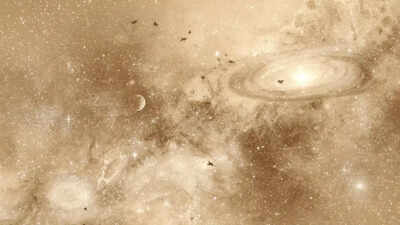
When you look up at the night sky, it seems deep black with bright stars scattered across it. That familiar view leads many to assume that the universe itself must be black. But astronomers have asked a different question: If all the light from every star and galaxy were combined into a single shade, what would the universe’s colour be? In 2002, a team of astronomers undertook this exact calculation and came up with a surprising answer. Instead of black, the average colour of the light from the universe is a very light beige, a shade they affectionately named “cosmic latte“.This finding came from analysing observations of hundreds of thousands of galaxies. Researchers measured all the visible light emitted by these galaxies and combined it into one “cosmic spectrum.” When that spectrum was converted into a single visual colour using standard colour science methods, the result was a creamy off-white tone. This represents a true average of all visible light from the universe, not how any single person would see the sky from Earth.The name “cosmic latte” may sound silly, but it is based on real scientific research. This average colour can help astronomers learn about the universe’s big properties and how the light from all stars has changed over time. It also shows how the light we get from galaxies that are far away changes depending on the age and type of star.
How astronomers calculated the universe’s average colour
In the early 2000s, astronomers Karl Glazebrook and Ivan Baldry coordinated a project that used data from the 2dF Galaxy Redshift Survey, one of the largest visible galaxy surveys ever completed. This survey mapped the light from over 200,000 galaxies in the sky, measuring their brightness at various wavelengths. The scientists did not examine each galaxy individually. Instead, they combined all of this information to create a single spectrum of light that can be viewed in space. This is the cosmic spectrum, which depicts all of the light emitted by stars, gas, and other celestial bodies. After scientists assembled the cosmic spectrum, they employed computer systems and color-matching procedures widely used throughout the world to convert it into a visible colour.The final colour is a light beige with the code #FFF8E7. This number comes from standard digital colour systems and lets cosmic latte be used in graphics and educational materials.
Why the universe isn’t black even though space looks dark
It might seem strange to say that the universe has a colour when space looks dark. The reason has to do with how we define colour and how our eyes see light. Most of the sky doesn’t have a visible light source, so space looks black. Photons from faraway stars and galaxies are too faint to see without telescopes. But scientists don’t get darkness when they add up all the light that can be seen from every bright object in the universe.The electromagnetic spectrum has a lot of different types of light, but visible light is the only one that people can see. By adding up the visible wavelengths that stars of all ages and types give off, scientists were able to make a composite colour. The cosmic latte is beige-white, which means it has light from both young blue stars and older red or yellow stars.This average colour has changed over the course of cosmic time. Early in the universe’s history, massive, short-lived blue stars dominated light emission. As those stars aged and faded, and more long-lived red and yellow stars became common, the average light shifted slightly toward longer wavelengths, giving today’s average colour its warmer hue.
The science behind the name “cosmic latte”
After the average colour was computed, the research team held an informal poll to choose a name. Options included playful suggestions such as cappuccino cosmico, big bang beige and skyvory. The name cosmic latte won out because it closely represented the creamy, pale colour produced by the calculations. The choice reportedly also reflects a lighthearted approach to science, helping make complex astrophysical data more relatable and engaging for the general public and students alike.As per reports, the term caught the public’s imagination and has since been used by NASA’s Astronomy Picture of the Day project, science outlets and textbooks to describe the universe’s average colour. The adoption of a familiar coffee reference makes it easier for readers and students to visualise this otherwise abstract scientific result.
What this tells us about the universe
It’s not just interesting that the universe has a colour that is average. It helps scientists figure out how light from stars spreads out over time in the universe. The cosmic spectrum tells us about the ages, numbers, and evolution of stars. The universe’s overall light signature changes as bigger stars die out and cooler stars take their place.Cosmic latte doesn’t change how the universe looks to someone on Earth, but it does show how stars have formed over billions of years and how the mix of light has changed. It shows how astronomical data can give us new information about the universe as a whole by looking at a familiar question in a new way.