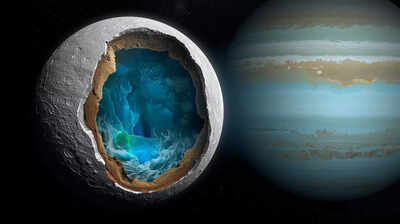
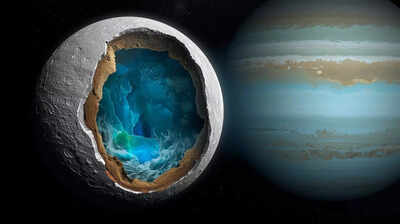
Miranda does not look like a typical small moon. The surface, seen in detail only once during Voyager 2’s flyby in 1986, carries scars that seem out of scale with its size. Wide fault systems cut across older cratered ground. Three large regions known as coronae interrupt the terrain with ridges and grooves that appear younger than their surroundings. A new peer-reviewed study in The Planetary Science Journal takes another look at those structures. Using geological mapping and computer stress models, researchers tested how thick Miranda’s ice shell may be and whether a subsurface ocean could have existed in the recent geological past. Their results suggest a thin outer shell and the possible presence of deep liquid water long after the moon first formed.
Uranus moon Miranda may have had a deep ocean beneath thin ice shell
The team identified ridges, furrows, and craters throughout Miranda’s southern hemisphere. Arden Corona and Elsinore Corona, located on opposing sides of the moon, were the focus of attention. The two regions don’t appear alike. Arden is distinguished by furrows and terrace-like scarps, which are commonly associated with extension. Elsinore displays folded and ridged topography, which is more consistent with compression. That contrast is important. When mapped structures were compared to expected stress patterns, certain interior models aligned better than others. Some stress patterns were consistent with the fractures’ broad layout. Others were not.
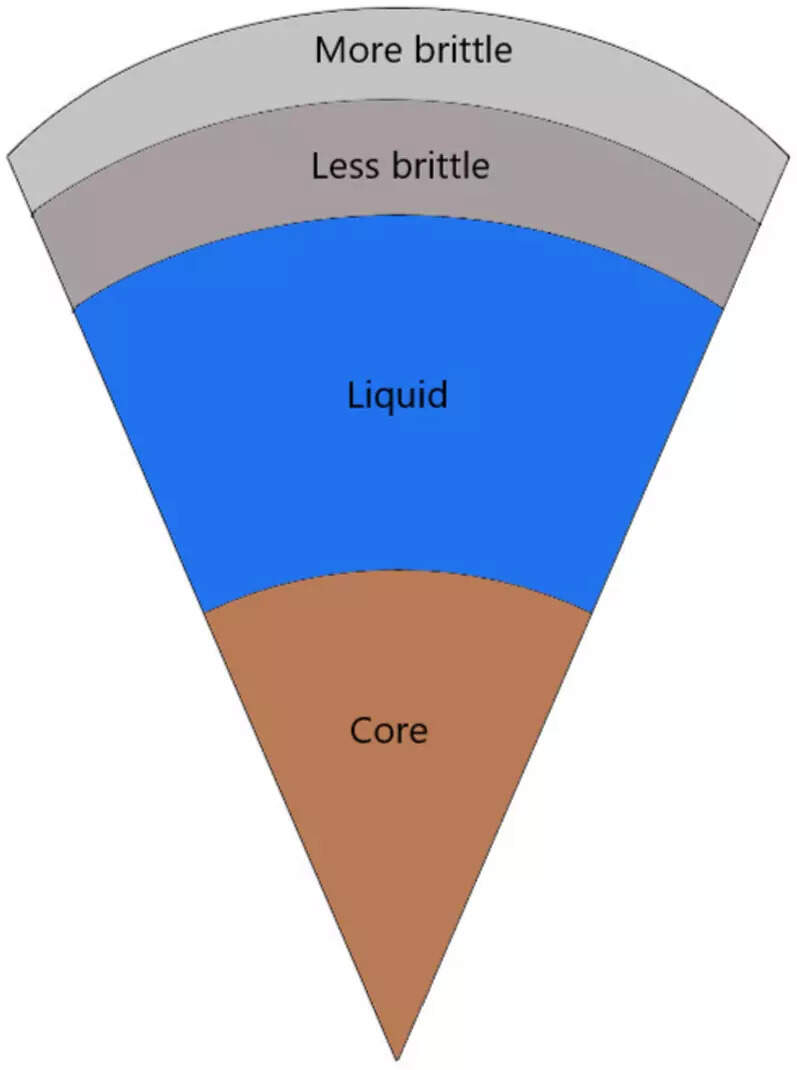
Uranus moon Miranda may have had a deep ocean beneath thin ice shell (Image Source – The Planetary Science Journal )
Thin ice shell allows stronger tidal fracturing
Computer simulations tested tidal forces caused by orbital eccentricity and possible shifts in spin axis, along with stress from ice shell thickening. Across many scenarios, a consistent pattern emerged. If Miranda’s brittle ice shell was around 30 kilometres thick or less, tidal stress could reach levels high enough to fracture surface ice.Thicker shells reduced the stress below likely failure strength. In those cases, the observed scale of tectonic disruption became harder to explain.
Deep ocean may have existed in recent geological time
The same models indicate that a subsurface ocean more than 100 kilometres thick could have persisted between 100 and 500 million years ago. That is recent in planetary terms.Evidence remains indirect. Voyager 2 saw only one hemisphere. Still, the combination of mapped geology and stress modelling adds weight to the view that Miranda was not always frozen solid. Small, distant, and outwardly quiet, it may have held heat for longer than once assumed.