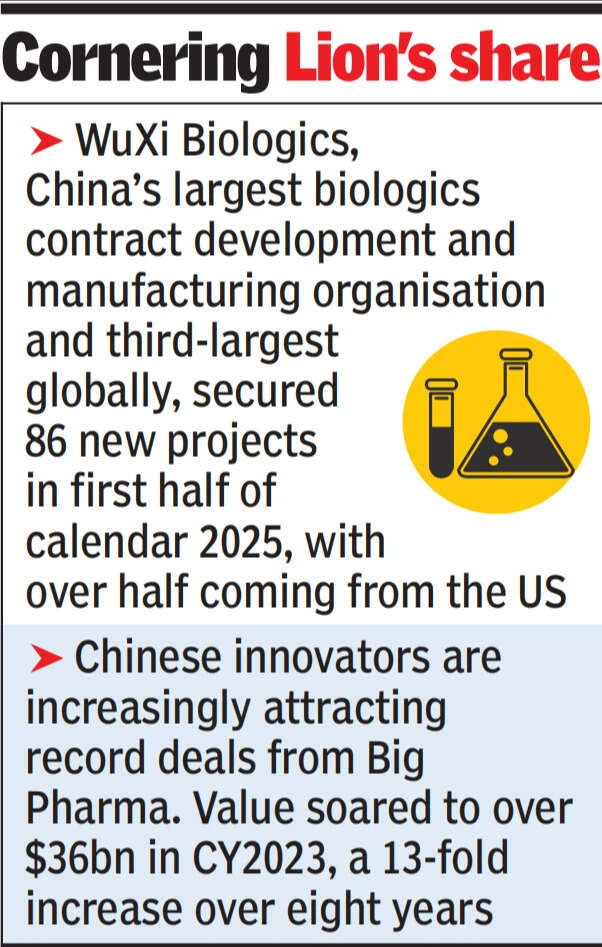
NEW DELHI: Indian firms hoping to ride the global biologics boom are finding the path far tougher than expected, as China tightens its grip further on biotech supply chains. Recent data suggests Chinese companies have bagged more than half of several recent project deals from US biotech companies, underscoring the challenge for Indian players trying to break into complex biologics.Unlike generics, where India leveraged cost efficiency and scale to capture global markets, biologics demand deep R&D capabilities, sophisticated manufacturing infrastructure and specialised talent, raising both entry barriers and financial risks, analysts say.
.
Over the last few years, China has rapidly emerged as a major force in biotech, with biologics accounting for about 42% of its new drug approvals in 2023, up from 9% in 2015, cementing its position in global supply chains for complex niche biologics. Against this backdrop, Indian companies will need to recalibrate strategy if they are to carve out a meaningful share in advanced therapies.K V Subramaniam, president, Reliance Life Sciences, said: “In last seven years, China has come from behind and forged way ahead of India in biopharmaceuticals, driven by mission-driven govt policy, fast-track regulatory approvals and clearance of a huge drug approval backlog.”“Recent project flows suggest Chinese companies have been able to secure more than half of their new orders from US-biotech companies, indicating Chinese companies’ operational scale, cost competitiveness and established capabilities remain unmatched,’’ said Tausif Shaikh, India analyst pharma and healthcare at BNP Paribas.Market research firm, IQVIA estimates 118 biologics are losing patent protection in the US (2025–2034), representing a ~$232B global biosimilar market. India’s biosimilar exports, currently around $0.8 billion, are projected to grow five-fold to $4.2 billion by 2030, and then potentially to $30–35 billion by 2047.Shreehas Tambe, CEO & MD, Biocon says, said, “India’s biosimilars industry is at a pivotal stage — the early years were defined by cost efficiency and established India as a reliable producer of high-quality generic medicines at scale. The next phase will evolve from cost leadership to capability leadership.’’“Though India has the broad capability, it has to address gaps such as cell line engineering depth, legal/IP plus market access firepower in the US, manufacturing at commercial scale of newer modalities from hybrid science like cell and gene therapies,’’ said Suresh Subramanian, national lifesciences leader, EY-Parthenon India.