
Once a thriving village, Vadakkanad in Wayanad district has now become a shadow of its former self: dilapidated buildings at its square, many uninhabited houses and desolate farmland.
A 67-year-old Vadakkanad farmer, Narayanan Chetty, says he has abandoned his five acres of land. “No villager wants to do farming here since by the time crops grow or the harvest period approaches, everything would be raided by elephants or other wild animals. Everyone wants to leave the village. Anyone who has resources to buy even five cents of land (for constructing a house) elsewhere are leaving this village. A majority of us living here are unable to migrate to safer places – we are struggling to survive here,” he says.

With Kerala headed for the Assembly elections on April 9, Vadakkanad in the Sulthan Bathery Assembly constituency could be seen as a microcosm of several regions in the state, where the human-animal conflict has emerged as one of the major talking points in poll discourse.
The issue, which has a bearing on the lives of a large section of voters, has taken a toll on social life in Vadakkanad. Those who go out of the village for work have to return by dusk. If the journey gets delayed, they are susceptible to attacks of wild animals from local plantations abutting forests at night.
The village’s Catholic parish currently comprises only 96 families. “We have 20 men in the age group of 20-40, who are unmarried. Other communities too have the same issue. No one is willing to marry off their daughters to grooms from this area. People have abandoned farming and youths have gone to nearby towns in search of sundry jobs. A few homemakers have gone abroad to work as house maids as their men cannot earn their living from farming here,’’ said parish priest Jose Moloparambil.
About 50 families are said to have moved out of the village in the last 15 years. Some of them have sold their land, with several living on rent elsewhere.
The village’s Orthodox church comprises 23 families, 10 of whom have shifted to Sulthan Bathery town, which also regularly witnesses cases of elephant raids. Vadakkanad is among many villages located in Wayanad’s forest belts, with the district having a nearly 36% forest cover.
“Our people are totally disappointed. Neither the government is concerned about our lives nor any parties. Wildlife gets a better consideration. We are not enthused about elections. Who can help us, who will save our lives and farms. Animals do not have enough fodder in the forest and they are foraying into our lands. The families staying back are those who do not have any other resources for livelihood outside. Compensation for crop loss is meagre and frequent wildlife attacks have demoralised all farmers,’’ says Sudheesh, another Vadakkanad farmer.
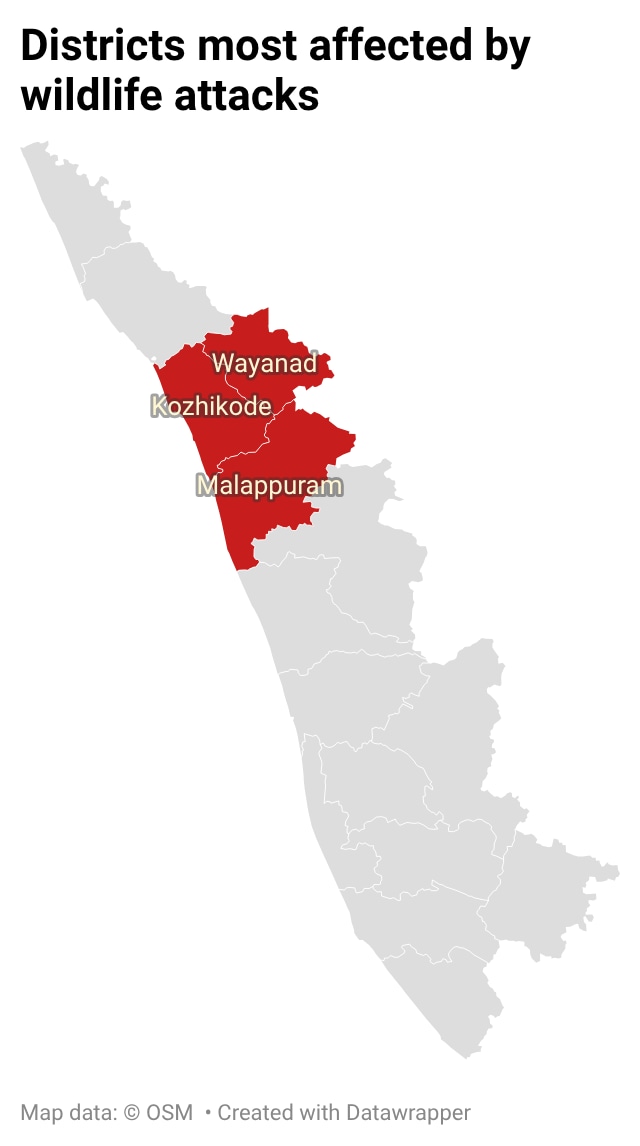
Around 100 km away, the residents of Poozhithode village in Kozhikode’s Perambra constituency have also been reeling from wildlife attacks, with about 90 of its 360 families resorting to migration over the last few years.
“All of us are looking for options to move out as farming has become impossible in the village,” says Moly Ayitharamattam, who represents the village in Chakkittapara panchayat. “Bus services have also been reduced after people started leaving the village. Instead of four buses earlier, now only one bus ply to the village. A bank has moved out its branch due to shrinking business. Scores of farmers have abandoned their land, which would slowly become a forest cover. This has aggravated the situation.”
Thomas Plathottam, a Poozhithode farmer who migrated to neighbouring Kuttiadi town, criticises political parties for “not having a clear answer to this farmer issue”. He says: “Parties are blaming one another. The LDF government says the BJP-led Centre has to clear an amendment to the Wildlife Protection Act, 1972 to give more powers to the state to kill wild animals posing threat to human life. The BJP claims the existing law has enough provisions to address the issue, putting the blame on the state government.’’
Behind human-animal conflict
According to the Kerala government, 70 of the state’s 140 constituencies have been grappling with wildlife attacks, with 30 of them being severely affected by the crisis in terms of human deaths and farm destruction.
Apart from declining forest habitats and shifting agri-practices, a number of other human activities, including increased human presence in and around animal habitats, waste disposal and construction near forested areas, are considered to be among factors leading to increasing incidents of wildlife attacks across Kerala.
As per the government’s data presented in the state Assembly last month, 200 people were killed in attacks by wild animals (wild boars, elephants, bisons, tigers) in the state from 2020-21 to 2024-25. As many as 6,329 people were injured, while 233 died from snake bites outside forests. There had been 62,199 incidents of crop loss during this period. Of the state’s 941 panchayats, 273 have been affected by wildlife attacks, as per the official figures.
In Chelakkara constituency in Thrissur, the forest department has reported 191 incidents of wild elephants destroying crops in the last five years.
Blame game
The incumbent CPI (M)-led LDF, the principal Opposition Congress and the BJP have been blaming each other over the rising incidence of wildlife attacks, with Chief Minister Pinarayi Vijayan calling it a “serious social issue”.
“The LDF government has made frequent interventions. The Assembly also passed a Bill to amend the Wildlife Protection Act (in October 2025). But it has yet to get the Centre’s approval. The state cannot act alone. The state’s demand to declare wild boar as vermin (which will allow culling of the animal) has been repeatedly rejected by the Centre. The 1972 Act was brought in by Congress and now the BJP-ruled Centre is hindering its amendment, making the issue more complicated,” Vijayan said last week.
The Congress has sought to put the CPI (M) in the dock over the row. “The LDF government did not use the powers in the 1972 Act. The Bill to amend it was only a ploy to win votes. We had raised the issue four times in the Assembly, but the government was not ready for a debate,” state Congress president Sunny Joseph told The Indian Express.
The BJP targeted the LDF, with its state vice-president Shone George charging that the Vijayan government was “not effectively addressing this serious matter”. “The 1972 Act has enough provisions for curbing the wildlife attacks that pose threat to human life and crops. The Centre has communicated this to the state government, which is still blaming the former for the crisis,” he said.