
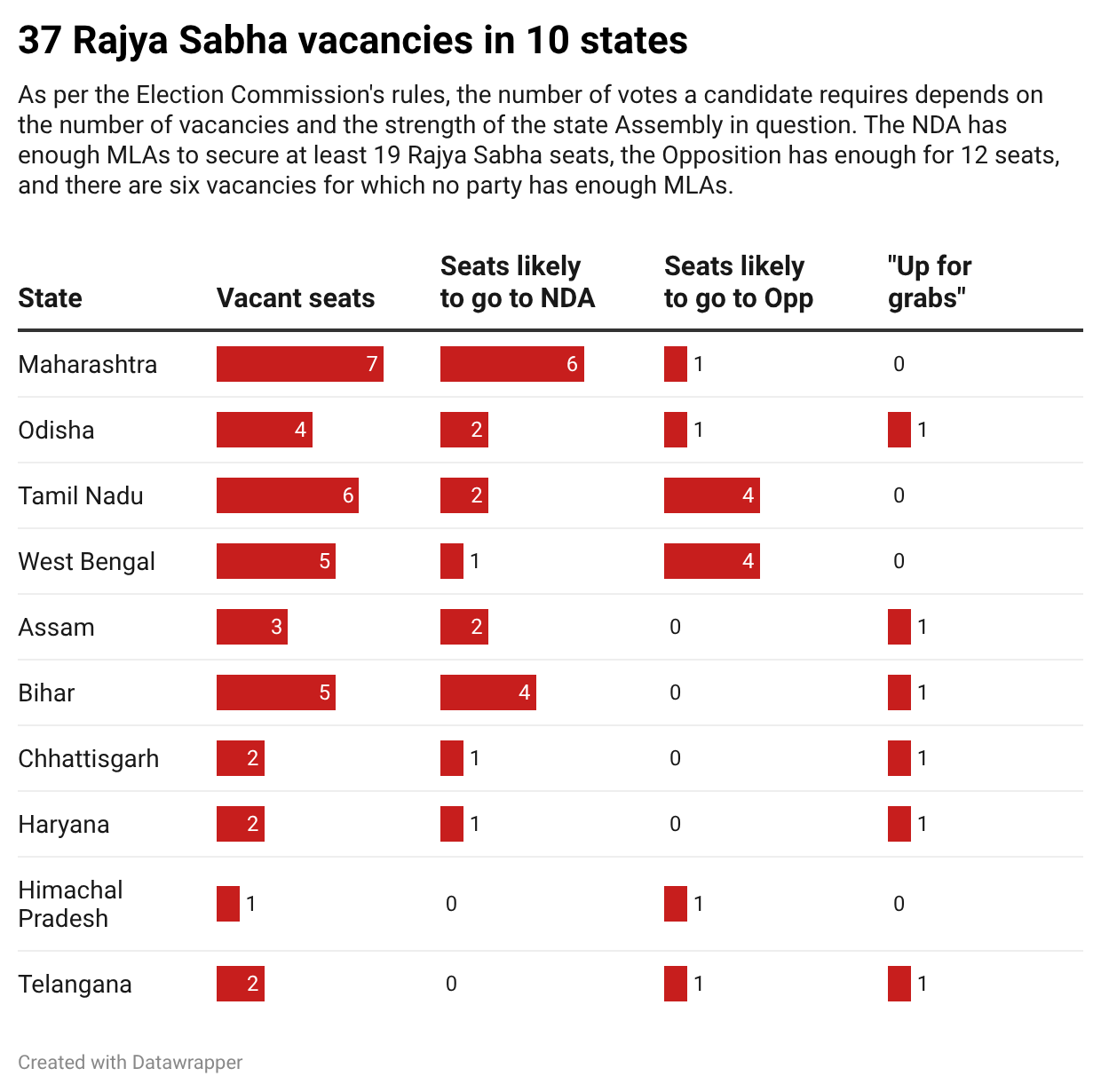
Ahead of voting on March 16 for 37 Rajya Sabha seats across 10 states falling vacant in April, the numbers give the BJP-led NDA a clear advantage over the national Opposition INDIA bloc, though at least six seats could go either way amid fears of cross-voting in some states.
The ruling NDA is likely to secure a boost in its Upper House numbers – the alliance is poised to win 19 seats unopposed. The Opposition INDIA bloc, which is set to win 12 seats unopposed, will see its Rajya Sabha numbers drop, with the elections coming as a test of the INDIA bloc’s unity.

As it stands, the NDA has 133 MPs in the 245-member Rajya Sabha, putting the alliance over the 122-seat majority mark. The BJP alone has 103 Rajya Sabha MPs, 20 short of an outright majority. The Opposition bloc has 79 MPs, including 27 from the Congress, 12 from the Mamata Banerjee-led Trinamool Congress, 10 from the M K Stalin-led DMK and five from the Lalu Prasad-led RJD.
A look at the Rajya Sabha election process and what’s at stake in each state.
How do Rajya Sabha elections work?
Rajya Sabha members are elected by state Assembly members through the system of proportional representation by a single, transferable vote.
The number of MLA votes needed by a candidate to win a Rajya Sabha seat depends on the strength of the Assembly of the state in question and the number of vacancies.
A formula is used to calculate the quota required for a candidate to win. The total number of MLAs voting in a state is divided by the number of seats going for elections plus 1. Then, 1 is added to the resulting number to calculate the quota.
Say the total number of MLAs voting in a state is 200 and elections are on for four seats.
In that case, 200 will be divided by 4+1, or 5, which will result in a figure of 40.
The quota thus will be 40+1, or 41. Any candidate getting 41 votes will be declared elected.
However, the system followed is that of a single transferable vote. So MLAs who vote can mark their first, second, third, etc preferences. If for any seat, candidates fail to get the specified number, the second- and third-preference votes will be taken into account.
In the above example, every candidate getting 41 first preference votes will be declared elected. If this does not fill all the seats, the surplus votes of those already elected are transferred to the second preference candidates of MLAs whose first preferences have already won, and so on.
Maharashtra – 7 vacancies
Maharashtra, with seven retiring MPs – including NCP(SP) chief Sharad Pawar, RPI (Athawale) president Ramdas Athawale and Shiv Sena (UBT)’s Priyanka Chaturvedi – accounts for the highest number of vacancies. Of these seven, three seats were held by the state’s ruling Mahayuti and four by the Opposition Maha Vikas Aghadi (MVA).
In Maharashtra, where the BJP-led Mahayuti has 235 MLAs in the 288-member Assembly, the NDA is likely to claim six of the seven vacant seats. Here, each vacant seat will require the support of 36 MLAs. The MVA, with 50 MLAs, can only secure one seat, meaning it will now have three fewer seats in the Rajya Sabha
While the Mahayuti has re-fielded Athawale, it has opted for new faces in five seats, including late Ajit Pawar’s son Parth of the NCP, BJP national general secretary Vindo Tawde, former BJP MLC Ramrao Wadkute, Dalit academic Jyoti Waghmare of the Shiv Sena. The Opposition, meanwhile, after intense deliberations, has re-nominated Sharad Pawar as its lone candidate.
Tamil Nadu – 6 vacancies
In Tamil Nadu, where six seats are falling vacant, the arithmetic is less complicated for the INDIA bloc. The DMK-led ruling alliance currently holds four of these seats, while the AIADMK and its ally Tamil Maanila Congress (Moopanar) hold the other two.
The DMK alliance, with 159 MLAs, has enough legislators to win four seats, requiring the support of 33 MLA for each seat. The AIADMK-NDA alliance, which is in the state’s Opposition, has 75 Assembly seats, enough to secure the remaining two seats. All six MPs are set to be elected unopposed and no seats will change hands between the alliances in this election.
While the Congress has fielded one candidate as part of its Assembly election seat-sharing deal with the DMK, the Stalin-led party has fielded two candidates and ceded one seat to ally DMDK. On the Opposition side, the AIADMK has re-nominated sitting MP M Thambidurai while the other seat is set to be won by Anbumani Ramadoss, the chief of AIADMK ally PMK.
West Bengal – 5 vacancies
As five seats fall vacant in West Bengal, including those held by the ruling TMC’s Saket Gokhale and Congress’s Mausam Noor, a winning candidate requires the support of at least 49 of the Assembly’s 294 members.
With an overwhelming 223 MLAs, the TMC has enough support to win four of the five seats, while the Opposition BJP, with its 64 MLAs, can win only one seat. The Congress and CPI(M), which each currently hold one seat, now have no MLAs in Bengal and will lose their seats, to the benefit of the TMC and BJP.
The TMC has fielded several high profile candidates, including Supreme Court advocate Menaka Guruswamy who is known for arguing in favour of LGBTQ right, former Bengal DGP Rajeev Kumar, veteran Bengali actor Koel Mallick, and former BJP Union minister Babul Supriyo, who joined the TMC ahead of the 2021 Assembly polls. The BJP, meanwhile, fielded former state party chief Rahul Sinha.
Bihar – 5 vacancies
While the RJD in Bihar has been going all out to mobilise Opposition parties in favour of its candidate A D Singh for the fifth and only undecided seat, the ruling NDA may be on course to clinch all five seats. As part of its strategy, the NDA has made its ally Upendra Kushwaha, the Rashtriya Lok Morcha (RLM) chief, its fourth candidate to ensure his victory on the strength of its own votes.
Currently, the JD(U) and RJD each hold two seats, while Kushwaha holds the last seat.
Each candidate needs the support of 41 MLAs to win an Upper House berth. Given its strength of 202 MLAs in the 243-member Bihar Assembly, the ruling coalition is set to win four seats smoothly, even as its fifth candidate would require votes of just three more MLAs from the non-NDA camp. The RJD-led Mahagathbandhan has 35 MLAs and it will need the support of six more MLAs to be in a position to send one representative to the Rajya Sabha.
The BJP has fielded Dalit leader and ex-party MLA Shivesh Ram as its fifth candidate. Other NDA candidates include Chief Minister and JD(U) president Nitish Kumar, BJP national president Nitin Nabin, Union minister and JD(U) leader Ram Nath Thakur and Shivesh Ram.
The party holding the key to determine the winner of the fifth seat seems to be the AIMIM, which has five MLAs. Though RJD leader Tejashwi Prasad Yadav has held a meeting with the AIMIM, the Asaduddin Owaisi-led party has “still not forgotten the RJD poaching four of our then five MLAs after the 2020 Assembly polls”.
Odisha – 4 vacancies
Like Bihar, Odisha too will see a tussle for the fourth seat, as no party has the numbers to win it unopposed. Currently, the ruling BJP and Opposition Biju Janata Dal (BJD) each hold two seats.
However, since the BJP ousted the BJD from power in 2024, the BJP can call on the support of 82 MLAs, enough to win two seats unopposed given the minimum number of MLAs required to win a single Rajya Sabha seat is 29 in the 147-member Assembly. The BJD, with 48 MLAs, can win one seat unopposed, and has tied up with the Congress, which has 14 MLAs, to field a consensus candidate, noted urologist Datteswar Hota, to keep the fourth seat away from the BJP. However, the BJP too has fielded a candidate for the fourth seat, former Union minister and hotelier Dilip Ray.
Amid fears of cross-voting, the Congress has sent its MLAs to a resort in Bengaluru, while the BJD has issued directives to prevent cross-voting. However, on Saturday, both were unable to contact several MLAs. The BJD, in particular, will fear a repeat of a 2002 episode, when an expelled party leader had contested the Rajya Sabha polls as an Independent and won after at least 15 BJD MLAs cross-voted in his favour.
Assam – 3 vacancies
Minimum MLAs required per winning candidate: 32
Chhattisgarh – 2 vacancies
Minimum MLAs required per winning candidate: 30
Haryana – 2 vacancies
Minimum MLAs required per winning candidate: 30
Telangana – 2 vacancies
Minimum MLAs required per winning candidate: 40
Himachal Pradesh – 1 vacancies
Minimum MLAs required per winning candidate: 35